Thursday, 8 March 2018

'Macbeth' at the National Theatre

'Macbeth' at the National Theatre on the Olivier Stage? Rory Kinnear as Macbeth? Well, obviously I had to go and see it. It's one of those awkward plays where I've yet to see a great production so maybe this will be it? 'Macbeth' is one of those plays where there's a lot going on and the director really needs to decide which avenue to take the production down and what story he really wants to tell. Rufus Norris directs this production and, since he's the current Artistic Director of the National Theatre, then this is really his baby.

I've seen Rory Kinnear in loads of things over the years (except his 'James Bond' role) and he's done the 'greats' of Shakespeare - Hamlet, Iago and now Macbeth, all on the Olivier stage - and I look forward to seeing his Lear one day when he's older. I really enjoyed his most recent roles in 'The Threepenny Opera' and 'Young Marx' and was looking forward to seeing what he would do with 'Macbeth'.

There's always that moment when you first walk into the Olivier Theatre and see the stage and the initial set - the stage is too big to be curtained off - and that sets the pattern for the thought processes. In this case, we had a funny looking bridge with totem poles and a backdrop of black plastic bags stuck together to create a rocky grotto or a waterfall (I'm not sure which). I quite liked it at first. What's all this meant to be then? It doesn't look like Scotland to me but I'm sure it'll all become clear at some point. Then, without any notice and while the audience was still chattering, a few people ran down the bridge followed by enemies and while some run off another is beheaded. And then the wyrd sisters arrive to open the dialogue. I wasn't quite sure why one of them kept running round and round the stage but why shouldn't she be on speed? She's a witch after all.

So. Quite a dramatic start and I'm all approving - drama, spectacle, blood, magic and weirdness. That's what I want. Then the play's off and running and we see characters all dressed a bit steampunk except the king who's in a cheap red suit. Then we see Macbeth's castle which seems to be a few concrete bunkers and I start wondering what's going on. Why would a great lord who commands an army dress and live like that? It makes no sense. Throughout history rich people dress richly, not in a hodge-podge of bits and pieces like anyone else. Otherwise, why be rich and powerful?

There seems to be a trend at the moment for 'ugly' productions. I saw 'Julius Caeser' a month ago which features Mark Anthony, one of the richest men in the world, wearing a cheap flannel hoody and I sat there thinking 'why would he wear that?' rather than listening to the text. Ugly productions can be very distracting and it didn't really help this production of 'Macbeth'. It must've been great fun to be let loose with the dressing-up box but isn't there more to putting on a great play on one of the nations great stages?  Doing a steampunk version might sound attractive in a rehearsal room but does it really work?

I also wasn't too keen on some the '90's elements of the production, like the boisterousness of the men at some points, banging tables and shouting 'oi! oi! oi!'. Really? That just struck me as lad culture gone to the extremes. This was particularly galling in the banquet scene in a  Nissen hut with folding tables and spindly chairs (exactly what you'd expect in a king's castle) and the queen dressed in pink bits and pieces. Are these people squatters or what?

I suspect part of the problem is directors and producers wanting to make Shakespeare 'relevant' to a modern audience, to young people, and attract people to the theatre. What they seem to forget is that Shakespeare's plays are being put on because they are great plays with universal themes and great poetry and don't need to be adapted. Let the play tell the story because, let's face it, it's a great story. Trust the material you've got in front of you, it's been around for 500 years and still works.

Overall, I think I quite liked this production - or, rather, some elements of the production - but wouldn't go back for seconds. I liked the weird witches in all their witchiness but I'm not sure why they climbed the totem poles in the final scene, I liked the main characters (until Banquo became a zombie rather than a ghost) and some of the acting was great but, I think, held back by the overall design of the production. Bits of the play seemed to have been switched around and cut for some reason but it flowed well enough.

I liked Kevin Harvey as Banquo (until he became a zombie), Trevor Fox as the porter and Amaka Okafor as Lady Macduff, all great performances. I was less impressed by Patrick O'Kane as Macduff who came across as 'Belfast thug' rather than anything else.

Anne-Marie Duff was fine as Lady Macbeth and seemed to push her way through the awful patched rags she wore as a steampunk queen to give us some real emotion. And so did Rory Kinnear, especially in the quieter scenes. They both know how to speak Shakespeare.

There you are. I'm pleased I've seen it but I won't be going back to see it again. I'm still waiting for the great 'Macbeth'. One day ....

Tuesday, 6 March 2018

'All Too Human' at Tate Britain

I braved the snow and cold to visit the new exhibition at Tate Britain, 'All Too Human: Bacon, Freud and a Century of Painting Life'. The title sort of suggests it's all about life painting but it also included some paintings - not many - of painting the built environment, such as Auerbach's paintings of his North London stomping ground and works by some other artists. One of these paintings that stood out for me was 'Citadel' by FN Souza with it's strange jewel-like colours and dark background. But it was the life painting and portraits I wanted to see.

The focus was very much on the second half of the 20th Century which makes it a bit odd subtitling the exhibition as a 'century' of painting. The first room includes some works from earlier in the century, such as 'Polish Woman' by Chaim Soutine and two portraits of Patricia Preece (one clothed and one naked). We then rush forward to works produced after the Second World War and artists like Bacon Souza and William  Coldstream.

I was quite taken by Coldstream's 'Seated Nude' from 1952-53, by it's simplicity and accuracy. Look at that head and face, that is definitely a woman placed in a specific time with short hair, simply styled, and white body with some colour on arms and legs where they've been exposed to some sun. She is not idealised and, other than the hair style, could have been on the Number 19 bus this morning going to work. There were a couple of other nudes by Coldstream, including one of an older woman who was bare breasted but wearing a white skirt for some reason, but I liked the simplicity and honesty of this one. I wonder who she was?

There were a few paintings of the city by Frank Auerbach and Leon Kossoff, and one that really sprang to life was Kossoff's 'Children's Swimming Pool, Autumn Afternoon 1971'. I'm the right age to have been in that massively overcrowded pool in 1971 and I could almost hear the shrieking and laughing of the kids jumping in and splashing each other, and the teacher or life guard shouting at a group of boys up to no good. I've been there. Of course, no sane person would allow so many people in the pool at once.

I'm not too keen on Bacon but I was very impressed with the selection of portraits by Lucian Freud. I haven't seen that much of his work before so it was good to see so many of his paintings at the same time, some head and shoulders, some full body, big and small works from odd angles. One of the first we see is an early self-portrait ('Man's Head (Self Portrait I)'from 1963) with slabs of contrasting colour and vigorous brush marks. Bright highlights and darker tones easily capturing the image in a surprisingly simple and effective portrait.

Another of Freud's paintings that caught my attention was his portrait of Frank Auerbach from 1975-76. Again, it's deceptively simple and shows the shape of the forehead and nose with simple, blunt strokes that brings the painting to life. He added a touch of green to the skin tone here, used a brush stroke there and voila! a real life person captured in paint. I stood in front of this painting for a while trying to work out how he'd constructed this portrait and made it so life-like. I suspect that some of the colour of his shirt has made it's way into his face (I would've done that too).

The room is filled with other paintings by Freud, including portraits of Leigh Bowery and of Sue Tilley (both, strangely, asleep) and a large painting of Freud's assistant and his dog, 'David and Eli'.

There's a room full of paintings by Paula Rego which are worth viewing and a rather striking self- portrait of Celia Paul called 'Painter and Model' from 2012. I'm not entirely sure why this painting attracted me, a slender woman with an extreme hair-cut wearing a smock covered in paint spatters. Maybe it's the sheer messiness of the painting, with squeezed tubes of paint at her feet and the dirty smock covering her from shoulders to feet. Or maybe it's the stillness of the painting that simply says, 'I'm here'.

The final room included a huge painting by Jenny Saville, at maybe 6'x6' square, simply of her face called 'Reverse' from 2002-03. The label beside the painting says that she 'collected' images of flesh wounds to try to match the skin colours and this painting just radiates that, with the deep red flesh tones around the mouth. I wasn't the only viewer to be fascinated by this painting with a few others while I was there looking at it then at others and returning to it. It's a very strange and powerful image. And big.


So there you have it, my take on another exhibition at Tate Britain. It's not one of their best but it's definitely worth viewing and I'll be going back, if only to examine those Lucian Freud portraits again.

Sunday, 25 February 2018

'Lady Windermere's Fan' at the Vaudeville Theatre

Continuing the Oscar Wilde season at the Vaudeville Theatre is 'Lady Windermere's Fan' and they've really pushed out the fan motif with this one, with fans around the proscenium arch, on the curtain, the window and the back of the stage and even the floorboards. Well done to the designer! Of course, you don't go to the theatre to check out the designers work (well, I don't) but it was a very nice, clean design that we saw when the curtain rose.

'Lady Windermere's Fan' is another one of Oscar's mistaken identity plays, a play of misunderstandings and untold truths and, as you'd expect, a satire on 'society'. We're in high society here and everyone in the play has a title of some sort, Lord this or Duchess that, other than the common (but quite nice) Australian with his kangaroos and odd accent but great wealth. And, of course, the servants (but they don't really count, do they?).

The play opens with Lady Windermere arranging some roses on the morning of her birthday party and mentioning that her husband has got her a new fan (I think I'd be upset if that's all I got). Then the Duchess of Berwick arrives to commiserate with the Lady that her husband is obviously having an affair with Mrs Erlynne who is the talk of society. Lord Windermere arrives home and insists that Mrs Erlynne is invited to his wife's birthday party that evening but can't explain why. O dear, why do people do this?

The party is full of gossip, particularly about Mrs Erlynne who flirts with everyone. Lady Windermere, however, can't take the humiliation and decides to run away with Lord Darlington who has expressed his love for her. She writes a note to her husband and leaves but when she gets to Lord Darlington's rooms he isn't there and Mrs Erlynne appears to plead with her to return to her husband. And then the men arrive from their club, not quite drunk enough yet to go home. The ladies hide but, during the banter, Lady Windermere's fan is discovered and accusations fly. That is when Mrs Erlynne reveals herself to the assembled menfolk and when Lady Windermere can slip away unseen... I won't take the story forward since that will spoil it for anyone with tickets to see the play.

This production is great fun. I really liked the stripped back stage with it's bare floorboards in the shape of a fan, the few bits of furniture as props and the clean, light view we're offered. It works so much better than the traditional over-furnished Victorian drawing room. It gave the actors space to move, especially the ladies in their large frocks.

We are definitely in comedy territory here with lots of witty word play and laugh out loud moments. It's also very contemporary with the #MeToo moment except here it's th women letting their men off the hook to give them a break. It's directed excellently by Kathy Burke with a light touch and letting the writing tell the story.

As with the other play I've seen in this season we are given a musical interlude by the characters in the play between the acts and tis time we have the Duchess of Berwick singing with the collective servants of the household giving us a rude song. The Duchess came out between acts three and four to give is her ribald song about being touched on the bum - or 'fan' - with lots of sly looks at the ladies maid beside her as she got too enthusiastic with her instruments. I very much approve of these interludes.

This production is great fun and I'd happily see it again. Wilde is still obviously using his characters to express his views on 'society' and the 'lost child/lost parent' storyline is a bit obvious but that doesn't distract from the production in the slightest. Jennifer Saunders is great as the Duchess of Berwick (and our interlude singer) while Samantha Spiro is both coquettish and caring as Mrs Erlynne. Joseph Marcell is also worth mentioning as Lord Lorton with his bunch of red roses. I also liked Kevin Bishop as Lord Darlington who was gifted with the words that 'We are all in the gutter but some of us are looking at the stars'. It's quite nice that those words are repeated a few hundred yards down the Strand on a monument to Oscar Wilde opposite Charing Cross Station.

 If you get the chance then go and see this play - it's great fun and well worth seeing!

Friday, 23 February 2018

'Punk and the Pistols' at Regent Street Cinema

Regent Street Cinema put on a screening of an Arena documentary from 1995, 'Punk and the Pistols', and I was there. I didn't see the documentary back in 1995 so it was a bit odd to watch something that was already over 20 years old that was looking back at something that happened 20 years before the film was made - over 40 years ago in total.

Views on punk change over time, including the people who were directly involved, and they express their views differently. What we saw were views stuck in time in the early '90s as some of the main protagonists looked back to the '70s. Interviews with Vivien Westwood, Malcolm McLaren and Jordan, from Siouxsie Sioux and Captain Sensible and, of course, from Glen Matlock, Paul Cook and John Lydon (but not from Steve Jones). Interestingly, the documentary was made before the Pistols' first reunion gigs. There were some great clips of Poly Styrene and the Damned and even a brief look at the Clash and The Jam. There were other names interviewed including Richard Hell who claimed to have invented punk and said the New York Dolls invented throwing up in airports (personally, I suspect it was the beer and spirits that caused throwing up in airports). It was great fun and it was nice to look back at my youth.


The Q&A afterwards was a different matter entirely. We had Paul Tickell, the director of the documentary, and Jon Savage, punk chronicler. It was interesting to hear Paul talk about the background to some of the film, the logistical problems, delays in broadcasting until they'd secured an interview with John Lydon and his own memories of the time. Jon Savage tried to be a bit more intellectual and wide ranging and a little bit smug, saying that he thought punk was over by 1977 when it actually just broke out of London to the wider country.  

The Q&A was a car crash as these things usually are and the chair did nothing to try to manage or direct the session. It ended up with the usual thing of people making statements of their own views rather than questions and discussion, asking questions about topics that have already been covered and, because it's about punk, arguing with each other. O the fun we had.

The positive thing about the Q&A session (awful as it was) was that people still cared. That is a good thing. At one point Jon Savage commented that all the original punks were now in their 60s and a lot of the audience were as well (quite clearly in many cases). Time moves on but I wonder whether people are living in the past or whether they're living their own truths? I hope it's the latter.

Wednesday, 21 February 2018

'Satyagraha' at the Coliseum

Philip Glass's 'Satyagraha' is on at the Coliseum with the English National Opera. I saw his 'Akhenaten' there a couple of years ago  and thought it would be interesting to see another of his works. I wasn't quite sure what I was watching a couple of years ago and that experience was repeated last week at this performance.

The production tells a version of the tale of Mahatma Ghandi's early years in South Africa, some of which I'm vaguely familiar with but not to the extent of knowing about the specific incidents we saw on that stage. I'm also, you'll be surprised to hear, I'm sure,  not familiar with Sanskrit so couldn't follow the tale by listening to the words since there were no surtitles. It all came down to the visuals, and some of those were astonishing.

Phelim McDermott's visuals left the stage bare at times and at others incredibly rich with spectacle built upon spectacle. Giant animals made out of baskets appear out of nowhere, gods on stilts battle for supremacy and random pages from a newspaper create a swirling maelstrom that Ghandi both disappears into and is created from. What on earth is this? What am I watching? The answer is that I didn't know while I watched and still don't know. I don't really want to know since I'd much rather revel in the random artistry of the piece.

The singers and chorus are dressed variously as Victorian ladies and gentlemen and this gradually changes to dhotis and saris for many of the characters as the story progresses and Ghandi rejects British modes and adopts his traditional Indian dress and traditions. It struck me as rather strange at the time, something quite challenging in it's own way since we rarely see a stage full of people dressed in what we think of as traditional Indian garb.

The music is slow and stately, swirling and repetitious with the same phrases seemingly repeated endlessly. Far from making me nod off it actually kept my attention riveted to the music, possibly simply waiting to spot the moment when it changed, perhaps? That will remain a mystery. I have to say that I don't think I could listen to it without the visuals. This is definitely one of those pieces that relies on the whole, rather than it's parts, in order to work.

Toby Spence sang Ghandi with sopranos Charlotte Beamont and Anna-Clare Monk. Karen Kamensek was the conductor (who also conducted 'Akhnaten' a couple of years ago).

While I quite like simply revealing in the experience and not wanting to try too hard to understand it, something that simply increased my frustration as the production moved forward was the continuous slow pace of every movement. How on earth can someone physically move so slowly across a stage for just under three hours? Even the memory of it makes me feel frustrated and need to move with increasing speed.  I can only give the performers kudos for sustaining it but, c'mon people, have some regard for it might make the audience feel!

I wonder what the next Glass production might bring?

Sunday, 18 February 2018

'The Winter's Tale' - Royal Ballet Rehearsal at the Royal Opera House

I went to see a rehearsal of 'The Winter's Tale' by the Royal Ballet at the Royal Opera House, my first rehearsal so I wasn't too sure what to expect. What we got was a full run through of the ballet in full costume and with a full orchestra. The only difference from a 'real' performance was that the orchestra were in civvies (including the conductor), the bar was shut and there were no ice cream sellers (that I saw). Other than that, wow!

I saw 'The Winter's Tale' a couple of years ago and was delighted with Itziar Mendizabal dancing Paulina so I was very excited to be seeing her dance that role again in the rehearsal. She is the epitome of grace and strength and is a wonder to watch.

It was great to see that moment when jealousy emerges when Hermione places Leontes' hand onto her pregnant belly as well as Polixenes' hand, his great friend and the action stops except for Leontes dancing around his wife and friend as the jealousy takes hold. That moment is so powerful in dance. Thiago Soares danced Leontes and Marianela Nunez danced an impressive Hermione. But it's Itziar who won the day with her graceful lines and movement and it's Itziar who closed the performance being the last left on stage as the curtains closed.

I'm looking forward to more rehearsals now!

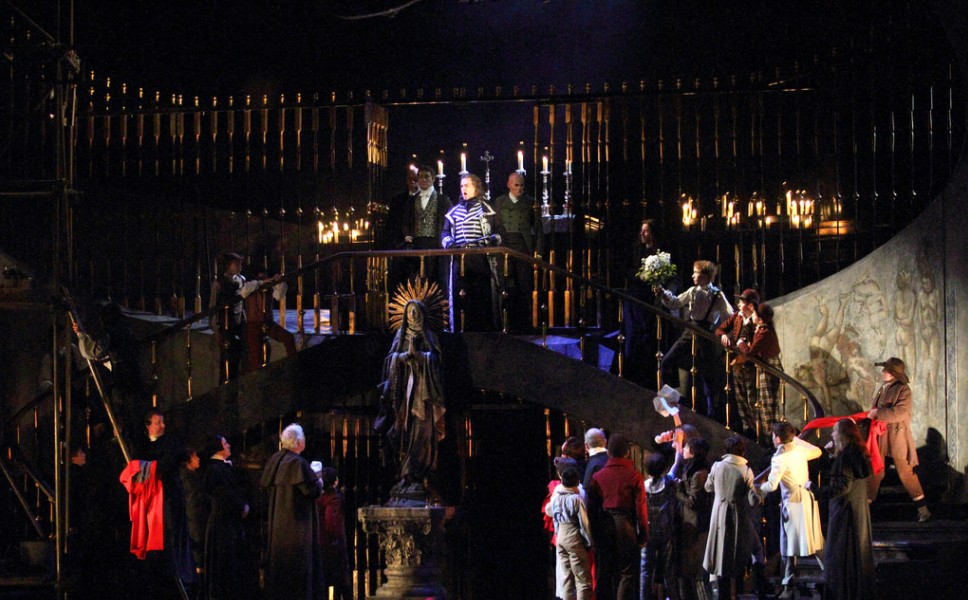
'Tosca' at the Royal Opera House

Last week I was lucky enough to see the Royal Opera perform 'Tosca' at the Royal Opera House, coincidentally, on the same evening it was broadcast live to cinemas. I saw 'Tosca' a couple of years ago performed by the English National Opera so it was nice to have the opportunity to see the Royal Opera put their spin on the tale. The story behind the opera is quite simple but riven with emotion and the music is just gorgeous (thank you Mr Puccini).

Mario Caravadossi is an artist painting in a church in Rome in 1800 and, although he uses a strange women who visits the church as his model for Mary Magdalene, his love belongs to Tosca. Floria Tosca is a famous singer with jealous, dark eyes, who comes to visit her lover to arrange a tryst later that night. But a senator has escaped from Castel Sant'Angelo and is hiding in the church and Caravadossi pledges to help him escape and the downfall of our lovers is set in motion. Baron Scarpia pursues the senator to the church and misses him but encounters Tosca who he's lusted after. He doesn't want to seduce her, he wants to conquer her, to own her and move on. The Baron arrests and tortures Caravadossi and will only release him if Tosca submits... and she does, to save her lover, before stabbing the Baron in the heart after he's given her a note of safe passage out of Rome with her lover. The man who is feared by all Romans and he's killed by Tosca for her love of Caravadossi.

The Baron plays true to form and he's lied to Tosca. She visits Caravadossi before his execution which should be fake but isn't and he's shot., When the troops come to catch Tosca for killing the Baron she refuses to submit and throws herself from the battlements of Castel Sant'Angelo. A great heroine who died for love.

'Tosca' is an astonishing piece of work by Puccini, edited from a longer play he saw to make a powerful three act opera. All the ingredients are there - love, jealousy, death, heroism, patriotism, lust, death and immortality - all melded into a rather simple story that wraps itself around you and pulls you into it before you've even noticed. Floria Tosca is a great heroine - her dark eyes might be jealous eyes but they're your eyes if she loves you.

Our beloved Tosca was sang by Adrianne Pieczonka and Caravadossi by Joseph Colleja with the Baron (boo! hiss!) sung by Gerald Finley. They were all in excellent form as was the Chorus of the Royal Opera.The lighting and set were great but I thought the final set for the roof of Castel Sant'Angelo could've done with a bit more work. I visited that roof last year in honour of Tosca so I know what it looks like.

Thank you Royal Opera, you didn't let me down.

Wednesday, 31 January 2018

'Annie' at the Piccadilly Theatre

'Annie' is one of those shows that most people probably know something about if only because it's an old story, it was a very successful film and it has some famous songs that are regularly covered. It is, however, a story I don't know because I've never seen the show or the film. I do know the famous songs, though. The reason I went to see it was really to see Meera Syal who took over the role of Miss Hannigan last year. Meera is an excellent actress and comedian so I wanted to see her song and dance steps.

We all know the story of 11 year old Annie in the orphanage run by Miss Hannigan during the depression. Oliver Warbucks, one of the richest men in the world, wants an orphan for Christmas and Annie is chosen by his secretary. She charms him and he wants to adopt her but, first, she wants to find her real parents. Hannigan's crooked brother turns up with a scheme to pretend to be Annie's father to swindle Warlocks out of money but the plot fails, the Hannigans get their comeuppance and all ends well for Annie, Daddy Warlocks and, it seems, his secretary. 

The show is, of course, liberally sprinkled with song and dance numbers by the stompy, energetic orphans leaping around the stage, by the down and outs of Hooverville, the dancers from the big screen film Annie sees and the staff of Warbucks' Mansion. I couldn't help feeling that not all of these musical interludes helped take the show forward or were strictly necessary but, on the other hand, what's not to like?

The story moved along at a fast rate, livened up every now and then by Amber the pooch - the real star of the show - scampering across the stage. Amber, who plays Sandy, always got a reaction from the audience. The sets changed quickly, everything seemingly on wheels, with the cast flooding on and off, one dance number after another with the cast of kids popping up every now and then to remind us about the orphanage. It was fun.

And Meera? She gave a solid, professional performance and yes, she can both sing and dance. She has a very good singing voice and should do more. She also does good drunk. Well done Meera, it was great fun to see you, just such a shame those pesky kids got in the way of your gin consumption!

Thursday, 25 January 2018

'Charles I: King and Collector' at the Royal Academy

The new blockbuster exhibition in London is all about Charles I's collection of paintings and other art works at the Royal Academy. And it is a BIG exhibition. It's full of room after room of great paintings with hardly a dull note and some works by artists I've never come across before. There are four tapestries designed by Raphael and nine enormous canvases my Mantegna showing a triumphal procession in ancient Rome, loads of portraits of Charles and the royal family by van Dyck, self-portraits by Rubens and van Dyck, Charles on horses, a room of miniatures and lots more besides. This really is an exhibition to linger over and there's something here for everyone.

I found myself mulling over how this exhibition came together and imagined the curators having a cuppa in the cafe one day and chatting about their dream exhibitions - if only we could get X Y Z together - and here they are. Charles I's collection was spread far and wide after his execution and, while many were subsequently bought back, many still reside in collections around Europe. This exhibition brings many of them together again.

One of my favourite paintings was 'Portrait of a Woman in Green' by Agnolo Bronzino. If you ignore those enormous green sleeves for a moment, you could easily see that woman on a bus or train going about her business today.

She is so fresh and 'real' with her patient face waiting to get on the next train because this one is too crowded. She looks kindly with a bit of backbone when needed, easily the manager of a busy office. That bright green dress against the rich, deep red background makes the painting really noticeable - how often do you see that rich green in old paintings? The painting was really noticeable and I'd love to know who she was and what happened to her. Maybe that's covered in the catalogue?

Another painting that caught my eye was a large one by Rubens, 'Minerva Protects Pax from Mars'. The titular characters are in the background while a great deal of frolic goes on in the foreground, presumably showing the benefits of a peaceful life and nation. I particularly liked the little group of children at the bottom-right of the painting - just look at those faces. I've no idea what that satyr is up to. And look at Minerva's arm pushing against Mars' shield - we don't quite see muscles and tendons pushing against her skin but that demonstrates her power against the god of war.

I also really liked the 'Adoration of the Shepherds' by Jacopo Bassano. The Virgin and Child are centre-stage in the brightest part of the painting while Joseph sits on the ground with his dog curled up beside him (I don't remember a dog being in the story but he looks cosy down there).

It's called 'adoration' but I didn't get that feeling from the shepherds, rather there's a suggestion that they're a bit agitated and don't really know what to do because they've never worshipped a baby before so they've brought a sheep as a gift. Well, what do you bring a baby that angels seem to know? Luckily, all is right with the world because the donkey and ox are there for consistency.

It was a surprise to see Jan Gossaert's curly-haired 'Adam and Eve', partly because of all the flesh on display - with a few exceptions, most of the paintings have fully clothed people in them. Of course, trees were really handy in Biblical times because they always seemed to sprout a branch at crotch height to avoid any embarrassment. Bit unfortunate if you walked into the branch though, especially if it had thorns. I'll leave that thought there.

Another painting I liked was of the royal kids by van Dyck with their enormous dog (and a tiny pooch). I stood there pondering dressing kids as little adults but then focused on the dog - if I was them I'd want to ride round on his back! He looks docile enough but has a striking musculature. It's also a bit of a show-off painting with all that beautiful fabric and lace on show, almost like van Dyck was saying, 'just look what I can do and how good I am - I'm certainly worth every penny you're paying me'.  And, indeed he was.


There were lots of paintings of Charles himself, mainly large, always regal and calm, sometimes outdoors on horseback and sometimes in a more courtly setting. His flamboyant clothes were always gorgeous and it's easy to imagine artists being very careful to ensure he's shown off to best effect. One of my favourites was a simple line drawing by van Dyck towards the end of the exhibition.

I've recently taken up drawing so it was fascinating to see this lesson from a real master, bringing the likeness to life without over-doing it and without filling the page with chalk. There's no shading or detail on the hat or clothes, it's all about the face. Very minimal with the lines but still brings the drawing to life. I bought the postcard of this drawing to keep with my drawing stuff as a reminder and a lesson. It really is quite marvellous in its simplicity. Thank you Mr van Dyck.

This really is an exceptional exhibition and I'll certainly want to visit again when the crowds of the first few weeks start to thin out a bit (at least I hope they will).