Showing posts with label Tosca. Show all posts

Wednesday, 26 June 2019

'Tosca' at the Royal Opera House

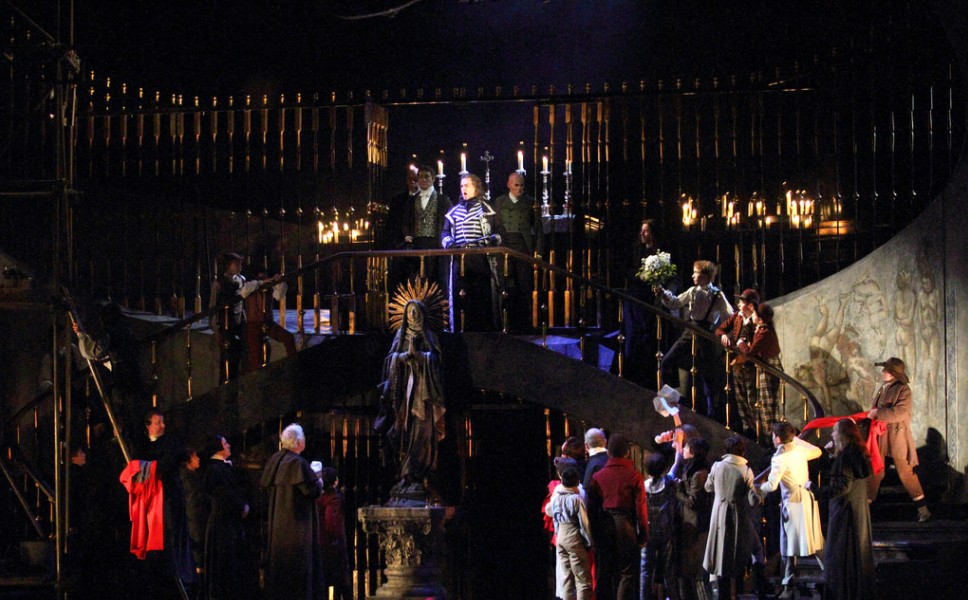
'Tosca' is my favourite opera and I've seen it three times in recent years at the Royal Opera House, the most recent viewing was the 512th performance of the opera by the Royal Opera.

It's the tale of Floria Tosca, a diva and the fiery lover of Mario Cararadossi, an artist and political radical who is arrested and tortured by the evil Baron Scarpia. We're in Rome in 1800 during the Napoleonic Wars and Scarpia tells us that he wants Tosca but not in a romantic love affair, he prefers to dominate and conquer then toss the conquered aside. With her lover arrested and tortured by Scarpia what is Tosca to do when he makes his wants known to our hero?

That is when Tosca gives us her great aria in which she sings that.

"I lived for art, I lived for love
I never harmed a living soul
With a discreet hand
I relieved all misfortunes I encountered"

Brave Tosca tells Scarpia she must save her lover so gives in to him, insisting that her lover should not be executed and that she gets safe passage to leave Rome. This she gets and, when Scarpia lays hands on her, she stabs him through the heart and kills him. Typically, Scarpia has lied and Cavaradossi is executed. Scarp's guards come for Tosca but she throws herself from the battlements of Castel Sant'Angelo to thwart them. Brave Tosca. It's a powerful, elemental tale of love and passion and power and lust.

Our Tosca was Kristine Opolais, Cavaradossi was Vittorio Grigolo and Scarpia was Bryn Terfel.

Sunday, 18 February 2018

'Tosca' at the Royal Opera House

Last week I was lucky enough to see the Royal Opera perform 'Tosca' at the Royal Opera House, coincidentally, on the same evening it was broadcast live to cinemas. I saw 'Tosca' a couple of years ago performed by the English National Opera so it was nice to have the opportunity to see the Royal Opera put their spin on the tale. The story behind the opera is quite simple but riven with emotion and the music is just gorgeous (thank you Mr Puccini).

Mario Caravadossi is an artist painting in a church in Rome in 1800 and, although he uses a strange women who visits the church as his model for Mary Magdalene, his love belongs to Tosca. Floria Tosca is a famous singer with jealous, dark eyes, who comes to visit her lover to arrange a tryst later that night. But a senator has escaped from Castel Sant'Angelo and is hiding in the church and Caravadossi pledges to help him escape and the downfall of our lovers is set in motion. Baron Scarpia pursues the senator to the church and misses him but encounters Tosca who he's lusted after. He doesn't want to seduce her, he wants to conquer her, to own her and move on. The Baron arrests and tortures Caravadossi and will only release him if Tosca submits... and she does, to save her lover, before stabbing the Baron in the heart after he's given her a note of safe passage out of Rome with her lover. The man who is feared by all Romans and he's killed by Tosca for her love of Caravadossi.

The Baron plays true to form and he's lied to Tosca. She visits Caravadossi before his execution which should be fake but isn't and he's shot., When the troops come to catch Tosca for killing the Baron she refuses to submit and throws herself from the battlements of Castel Sant'Angelo. A great heroine who died for love.

'Tosca' is an astonishing piece of work by Puccini, edited from a longer play he saw to make a powerful three act opera. All the ingredients are there - love, jealousy, death, heroism, patriotism, lust, death and immortality - all melded into a rather simple story that wraps itself around you and pulls you into it before you've even noticed. Floria Tosca is a great heroine - her dark eyes might be jealous eyes but they're your eyes if she loves you.

Our beloved Tosca was sang by Adrianne Pieczonka and Caravadossi by Joseph Colleja with the Baron (boo! hiss!) sung by Gerald Finley. They were all in excellent form as was the Chorus of the Royal Opera.The lighting and set were great but I thought the final set for the roof of Castel Sant'Angelo could've done with a bit more work. I visited that roof last year in honour of Tosca so I know what it looks like.

Thank you Royal Opera, you didn't let me down.

Friday, 14 April 2017

'Madama Butterfly' at the Royal Opera House

The latest operatic blockbuster at the Royal Opera House is the revival of Puccini's 'Madama Butterfly', an opera that he was inspired to write after seeing the original play on which it's based  performed at the Duke of York's Theatre on St Martin's Lane, half a mile away from Covent Garden. I'm still easing my way slowly into opera so am sticking to the 'biggies' of the genre and you don't get much bigger than 'Butterfly'. The closest I've ever come to it is Malcolm McLaren's record 'Fans' so I had little idea of what to expect and everything to learn. I saw the 408th performance at the Royal Opera House and this evening it was broadcast to cinemas around the world.

It's the tale of Cio-Cio-San's marriage to Lieutenant Pinkerton in Japan in the 19th Century and what happens next. Cio-Cio San is affectionately known as Butterfly, a young woman of 15 years old who has fallen on hard times due to the suicide of her father. She believes her marriage to the American Pinkerton to be a love-match but he sees it as a contract that can be terminated at a word. She gives up everything for him and even converse to Christianity for him, to better fit in with her idea of what an American would do and is. When her family finds out that she has converted she is cast out and alone in the world with her love of Pinkerton and her loyal handmaid, Suzuki.

The second half opens with Butterfly having been abandoned by Pinkerton after a few months and three years have passed since he sailed away. She trusts to his promises to return when the robins nest but Suzuki is less sure and the marriage-broker is already trying to have her wed a rich Japanese man. Butterfly will have none of it since she believes love is true and Pinkerton will return to meet their blond-haired son. Poor Butterfly is, of course, deluded, since Pinkerton is bringing his white, American wife and has ho intention of rejoining Butterfly. When he finds out about his son he is full of remorse and wants to take him back to America but can't see Butterfly so leaves that to his wife. Butterfly agrees that it'll be best for her son and then takes the ritual knife she inherited from her father and ends it all at the age of 18.  Poor Butterfly.

The entire opera takes place in one large room in Japanese style, with sliding doors to show gardens and roads but essentially everything happens in the same room. The lighting subtly changes the mood and moves from morning night and back to morning, particularly as Butterfly waits for Pinkerton. The music is lush and carries you away but, as usual, I get carried along by the characters. Pinkerton is a cad who should be horse-whipped and his friend, the Consul who he entrusts with important messages, is weak. Once again, it is the women who are strong in opera. Cio-Cio-San kills herself for love with a dagger through her heart and loyal Suzuki stays with her to the end while the anonymous Kate Pinkerton is left by her coward of a husband to pick up the pieces at the end. Men are such shits aren't we?

Cowardly Pinkerton was played by Marcelo Puente and the weak consul was played by Scott Hendricks. Ermonela Jaho played Cio-Cio-San/Butterfly and Elizabeth Deshong played Suzuki (who had, I thought, a tremendous voice and great delivery). Well done all and I heartily approved of the faint boos that greeted Puente/Pinkerton when he came on for his bows at the end.

I can't help but think that the brave Tosca would've killed Pinkerton herself before committing suicide. Butterfly, please take note for next time.

Sunday, 16 October 2016

'Tosca' by the English National Opera at the Coliseum

I'm not a great fan of opera. I've seen a few in recent years and the only one that's come close to making me 'get it' was 'La Traviata' at the Royal Opera House earlier this year. That involved me emotionally as well as having sumptuous sets and fantastic singing. Since then I've realised that I can potentially like opera, I just need to be careful which ones I choose to see until I have the magic revelation and I fall in love. I haven't seen any operas since 'La Traviata' until Friday evening when I went to see 'Tosca' at the Coliseum, home of the English National Opera (that sings everything in English).

A man enters a church furtively to find the key his sister has hidden that will let him hide in a small chapel before an artist enters to continue to paint a fresco on the wall. The subject is the furtive man's sister as a madonna. The artist's lover visits him and gets jealous over the blond hair and blue eyed subject but the artist reassures her that it is her he loves and her flashing dark eyes. They arrange to meet later that night. The artist is Mario Cavaradossi and the singer is Floria Tosca, our central characters.

When she leaves the furtive man emerges and it turns out he's a former consul of Rome and has just escaped from prison with the help of his sister. The artist is a supporter and swears to help him escape Rome. They hear police at the door of the church and make good their escape and that's when we meet Baron Scarpia, the chief of police (who I renamed Shitface for his evil nature). Baron Shitface wants to arrest and hang both the former consul and Caravadossi as traitors and he sets his agents to follow Tosca to find them.

Find them he does, through cruel torture of Caravadossi while poor Tosca has to listen to his cries. To save her lover she tells Shitface where the consul is hiding but he wants more. He's already told us that he wants Tosca - not to woo her gently as a lover, but to conquer her, to take her as he pleases and use her for his own enjoyment. To save her love she reluctantly agrees and demands a guarantee of free passage out of the city state of Rome. As Shitface starts to ravish her she stabs him in the heart and proclaims that a woman has killed the monster that all of Rome fears.

The scene moves to Castel Sant'Angelo, the prison where Cavaradossi is to be executed, and she assures him that the police will feign shooting him and he must lie still until she says he can move, then they will escape from Rome. But, of course, Shitface was lying and they shoot him anyway. As brave Tosca mourns her beloved the police appear having discovered Shitface's body and move to arrest her. No, they won't have her, and she throws herself off the battlements of the castle to follow her beloved in death.

This is a magnificent opera of love and passion and Tosca emerges victorious in defeating her enemy and depriving his minions of revenge. Puccini's music is marvellous and the story is told so simply and effectively translated into English by Edmund Tracey. Grand, swelling music one moment, quieting the next as the story progresses. It's such a simple story told so effectively and movingly.

My Tosca was Keri Alkema and Cavaradossi was Gwyn Hughes Jones. Shitface was Craig Colclough and he was righteously booed during the bows at the end. Serves you right! They all played their parts to perfection - especially the dangerous and menacing Shitface - believing the acting and rejoicing in the singing. I guessed that Shitface would lie about saving Cavaradossi but I didn't guess the tragic ending of Tosca throwing herself from the battlement. Such a brave and triumphant hero!


Thank you ENO and Keri for opening my eyes to another opera and introducing me to another hero. Thank you to Catherine Malfitano, director of the original production, and to Donna Stirrup, the revival director. Such a well crafted production with simple sets and lighting that helped focus attention on the story and the protagonists. I loved it!