Showing posts with label Royal Ballet. Show all posts

Saturday, 7 May 2022

Ashton Triple Bill at the Royal Opera House

Last week I went to see three one-act ballets by Frederick Ashton danced by the Royal Ballet at the Royal Opera House. My last visit was about 6 months ago to see Steven McRae dance Romeo in 'Romeo & Juliet', his first return to the stage after snapping his Achilles tendon over two years ago. 

The first ballet was 'Scenes de Ballet', a piece I've never seen before. It didn't grab me at all although I liked the music by Stravinsky. The dancing seemed rather formulaic and I wasn't always sure what I was actually seeing. At one point I remember being distracted by the lads' tunics, thinking they would make great tee shirts and the Royal Opera House should sell them in its shop. I should be thinking about the ballet not tee shirts.

The second was 'A Month in the Country' with music by Chopin, a ballet I've seen before and I could sink into the comfort and story of it. A rich family living in the countryside in their grand house, the bored mother flirting with a friend, the father mainly absent, two children and servants when a new tutor for the boy turns up. Obviously, the mother and tutor fall in love but the daughter has set her sights on him and she denounces them to the father. It ends sadly, but the love is real. Natalia Osipova was excellent as the mother, flirtatious and sad by turns, yearning for more than her life has given her. William Bracewell danced the tutor who can't bear to hurt his love and leaves quietly. 

The final ballet was 'Rhapsody' with music by  Rachmaninoff and it was my favourite. I've not seen it before but the lead was danced by Steven McRae so we were in safe hands (or feet). It was a perfect match of movement to music with Steven leaping and jumping, running round the stage leading the other dancers then vanishing into the wings to let Anna Rose O'Sullivan do her dances. This is a great role for a male dancer to spotlight their skills and Steven took full advantage of it. And even better, he looked like he was enjoying it. He was a joy to watch and I'd love to see him dance the part again. 

I don't have any more tickets to see the Royal Ballet in the immediate future - my next dance is flamenco - but that day will come again. They're too good to miss for long.

Monday, 25 October 2021

'Romeo and Juliet' at the Royal Opera House

Last week I went to see 'Romeo and Juliet' at the Royal Opera House, the ballet that made me fall in love with the art form and, luckily, the dancer who played Romeo in that production six years ago was dancing again. Steven McRae danced Romeo in 2015 and I was in the audience when he snapped an Achilles tendon in 2019 so I had to be there to see his triumphant return to the stage last week, once again dancing Romeo, with Sarah Lamb as Juliet. What a privilege to see this joyous ballet with such great and graceful dancers as my re-introduction to the main stage of the Royal Opera House. The Royal Ballet dance Kenneth MacMillan's version of this eternal story - I've also seen John Cranko's version in Boston and, more recently, Matthew Bourne's re-imagining of the tale, but I prefer the Royal Ballet. Prokofiev was having a good month when he wrote the score for this ballet. 

We all know the story behind the work, the rivalry between the two houses of Capulet and Montague in Verona, how Romeo falls for Juliet and pursues her to marry secretly while she is supposed to marry another nobleman. She feigns suicide to avoid the marriage but Romeo believes she is dead so commits suicide himself and when she finds him dead she follows him into death. Whenever we get to the marriage scene I can't help but wish they don't marry since marriage signs their death warrants, but they always do. Maybe one day the friar will refuse to marry them...

Needless to say, I loved it. It was great to see the excitement of the sword-fencing scenes again, see the Happy Strumpets strut their stuff and see Romeo and his mates enjoying themselves before tragedy strikes. There were a few tense moments when Steven McRae took off to fly across the stage but he was on top form and seemed to revel in performing again. It's what he does, after all. He received huge cheers when he strode on stage at the start of the performance and an even louder ovation at the end, with Sarah Lamb pushing him forward for bows at the end and to accept the cheers and love from the audience. The bows at the end are usually led by the ballerina but that night it was all for Steven, and rightly so. 

And I still love that ballet.

'L'Heure Exquise' at the Royal Opera House

'L'Heure Exquise' is a work by Maurice Bejart based on Samuel Beckett's 'Happy Days'. In the play, the lead character is buried up to the waist in rubble so in this dance version, she is buried in pointe shoes. The lead was played by the ever-graceful Alessandra Ferri partnered by Carsten Jung. Ferri has a long relationship with the Royal Ballet, training at the Royal Ballet School and joining the company in 1980, achieving the rank of Principal dancer and later becoming Prima Ballerina Assoluta. And she's still dancing. 

The performance was in the Linbury Theatre, much smaller and more intimate than the main stage, and it's great to be so much closer to the dancers. Ferri tells her stories of her past through words, song and, of course, dance. It starts with her buried to her waist in ballet shoes and then the mound of shoes opens up and she steps onto the stage to sift through her memories. One minute she's singing then the next she's riding Jung like a childhood rocking horse. He was a very able partner, morphing into whatever Ferri needed.


The most tense and puzzling section for me was when Ferri discovers a handbag full of memories - a compact, a pair of ballet shoes - that she takes out one by one, and then she pulls out a gun and holds it up in the air. What is that for? Why is it there? What happened in her past to make a handgun such an important memory? Especially when she points it at Jung and he slowly takes it from her. Clearly an important memory and, like the rest of the show, a puzzlement...

For most of the show I had no idea what was going on - just like when I saw the 'Happy Days' play a few years back - so I just let it wash over me. You don't always have to understand everything, sometimes just experiencing it is enough. It's always a delight to see Alessandra Ferri and admire her skill and art and I look forward to the next time.

Monday, 30 December 2019

The Plastic Bag Awards 2019

It's time for annual awards fest in the Plastic Bag so let's jump right into the Baggies 2019!

Best Shakespeare

There's normally a good selection of productions of Shakespeare plays to choose from but this year I've only seen one play, 'Romeo and Juliet', and then again, it's not even the Shakespeare play, but two dance versions and a film version. The nominees are:

* 'Romeo and Juliet' @ the Royal Opera House
* Matthew Bourne's 'Romeo & Juliet' @ Sadler's Wells
* 'West Side Story' @ British Film Institute

The award must go to Kenneth MacMillan's wonderful choreography and the dancing of the Royal Ballet in 'Romeo and Juliet'. The joyousness of it, the spectacular sword fencing, the leaping and flying of the cast and the Happy Strumpets all make this production a winner.


Best Drama

I saw quite a few plays over the year, many of which were good but lacked that certain something that would put them in the Baggies as nominees. The successful nominees are quite varied in subject matter, from a fantasy full of special effects to a Jamaican wake to life in a northern town and a glitzy West End farce to a one-woman play about a young secretary working for the nazis during the last war. The nominees are:

* 'Harry Potter and the Cursed Child' @ The Palace Theatre
* 'Rutherford and Son' @ the National Theatre
* 'Nine Night' at the Trafalgar Studios
* 'Present Laughter' @ the Old Vic
* 'A German Life' @ the Bridge Theatre

The Baggie goes to the one-woman powerhouse of Dame Maggie Smith and 'A German Life', a strange tale in which the character has convinced herself that she knew nothing about the Holocaust despite working as a secretary in the nazi high command in Berlin. A powerful performance for a powerful play.


Best Musical

This has been a good year for musicals, with a  wide variety produced over the year. The long list went beyond the five nominations allowed so these are the really stand-out productions. The nominees are:

* 'Blues In The Night' @ Kiln Theatre
* 'Fiddler On The Roof' @ Playhouse Theatre
* 'The Bridges Of Madison County' @ the Menier Chocolate Factory
* 'Come From Away' @ Phoenix Theatre
* 'Girl From The North Country' @ the Gielgud Theatre

None of the nominations are particularly cheerful. A down-at-heel hotel in 'Blues', the oppression and forced migration of 'Fiddler', the chosen migration of 'Bridges', the terrible background to 'Away' and the 'depression of 'Girl' - none are a bundle of laughs. The Baggie goes to 'The Bridges of Madison County' for it's tale of love and loss with the marvellous Janna Russell leading the cast.


Best Entertainment

I classify 'entertainment' as something that happens on a stage (big or small) but isn't necessarily a play, musical or dance. This year there are three nominees:

* Tracey Thorne interview and Q&A to launch her latest book @ Waterstones
* 'A Room of One's Own', a Virginia Woolf reading @ Sam Wanamaker Playhouse
* Amanda Palmer 'There Will Be No Intermission' @ Union Chapel

It's always a delight to hear Tracey Thorn talk since she's articulate and intelligent and only a couple of years younger than me so we share lots of similar memories. 'A Room of One's Own' was a delight to hear of rate wide-ranging ideas discussed and a reminder of the book I last read decades ago. But the Baggie must go to Amanda Palmer for her nearly four show on her 'There Will Be No Intermission' tour. Amanda would normally go into the 'Gigs' category but this wasn't a gig, it was something else, something powerful in which she shared intimate moments of her life unselfishly to tell us we're not alone. A very brave show on so many levels. Well done Amanda.


Best Gig

Not many gigs this year but I had the joyous madness of The B-52s, the poptastic bouncing of Alphabeat and the soaring voice of the lovely Kelli O'Hara (although hers was definitely a concert rather than a gig).

* B-52s @ Hammersmith Apollo
* Alphabeat @ Hackney
* Kelli O'Hara @ Cadogan Hall

The Baggie can only go to those B-52s, to Fred, Cindy and Kate and their great band for giving me such a fun night out and a chance to relive all those great hits from yesterday that still stand up.


Best Dance

It's been a funny year for dance, with more revivals by the Royal Ballet, a welcome revival by Akram Khan and a new Matthew Bourne. The nominees are:

* Akram Khan's Giselle @ Sadler's Wells
* Matthew Bourne's Romeo & Juliet @ Sadler's Wells
* Emociones @ Teatro Alfil, Madrid
* The Suit/Ingoma by Ballet Black @The Linbury Studio, Royal Opera House

The winner is obvious to me and I'm pleased that the judging panel agreed - the flamenco at Teatre Alfil in Madrid! It was a stunning sight, feet pounding the floor a thousand times a second, dramatic shapes, passion and lots of sweat. I want to see more flamenco - no, I need to see more flamenco - and I look forward to the summer season at Sadler's Wells.


Best Performance

Best performance is an award given to someone for doing something that little bit special in acting, singing, reciting, whatever. Interestingly the nominees this year are all women: Jenna Russell as the Italian immigrant to America; Maggie Smith as the German women fooling herself over working for the nazis; Cordelia Braithwaite as a feisty Juliet jumping on Tybalt's back to protect Romeo; and Amanda Palmer telling the truth of her life.

* Jenna Russell in 'The Bridges of Madison County'
* Maggie Smith in 'A German Life'
* Cordelia Braithwaite in 'Romeo and Juliet'
* Amanda Palmer @ Union Chapel

The award goes to Amanda Palmer for her astonishing show 'There Will Be No Intermission' in which she's on stage for just shy of four hours baring her soul and telling us about the most intimate things, about abortions and miscarriages, about first loves and the death of a close friend. There are laughs in the show as well as sadnesses, it's well paced and well constructed, sprinkled with songs but mainly Amanda talking to us. Well done!


Best Exhibition

This has been a bumper year for exhibitions and I could easily add more to the nominations - Bonnard at Tate Modern, Sorolla at the National Gallery, William Blake at Tate Britain - but the nominees were a cut above the rest for different reasons. We have early Renaissance masters, imaginative print-makers, magically weird installations and colourful cartoons with a message.

* 'Florence' @ Alte Pinakothek, Munich
* 'Cutting Edge: Modernist British Printmaking' @ Dulwich Picture Gallery
* Olafur Eliasson @ Tate Modern
* 'Fra Angelico and the Rise of the Florentine Renaissance' @ the Prado, Madrid
* Keith Haring @ Tate Liverpool

In most years, the Alte Pinakothek exhibition of 15th Century Florentine works would win hands down for the sheer range of works and artists, the recreated altarpieces using available predella panels, the choice of little-seen paintings, large and small. An outstanding and carefully curated exhibition. But it's been pipped at the post by the astonishing Fra Angelico exhibition over the summer at the Prado. There aren't enough superlatives to praise that exhibition which presented little known works from around the world as well as the gloriously restored 'Annunciation' as the centrepiece of the exhibition. Truly astonishing. Well done Prado!


Best Film

I saw more films than usual this year, from the grand expanse and effects of 'Avengers Endgame' to the small but razor sharp documentary about Suzi Quatro, from the old of 'Goodbye Mr Chips' (that I;'m including since I've never seen it before) to the latest Almodovar film.

* 'Avengers Endgame'
* 'Suzi Q' documentary
* 'Pain & Glory'
* 'Goodbye Mr Chips'

The Baggie goes to Almodovar and Banderas for 'Pain & Glory', a marvellous film about an ageing film director with health problems getting his mojo back. Maybe it was the raging thing that touched me but I loved it. I loved the colours, the story telling, the characters, the sunshine and light of Madrid, it all worked for me. Well done!


And there you have it, the peak of culture and art in my world in 2019. I wonder what will happen in 2020? We'll see...

Tuesday, 17 December 2019

'Coppelia' at the Royal Opera House

'Coppelia' has replaced 'The Nutcracker' as the Royal Opera House's Christmas ballet this year so we had to go and see it, particularly since we've not seen it before. There's something about ballet that makes it a perfect Christmas entertainment and the Royal Opera House celebrates Christmas  - it was only afterwards that I realised that I hadn't had a mince pie or gingerbread Nutcracker in the interval. Maybe next year.

'Coppelia' isn't a tale to tax the brain cells. It's based on a Hoffman story about an old toymaker who makes mechanical life-sized toys. And that is what Coppelia is, a wind-up toy, but a beautiful toy. Swanilda notices that her fiancé Franz is quite taken with the beautiful young lady sitting in the window of Dr Coppelius's house. When Dr Coppelius drops his keys in the street Swanilda finds them and goes into his house to find out who this girl really is and, by coincidence, Franz is climbing up a ladder into Coppelia's room.

Swanilda finds Dr Coppelius's workshop full of mechanical dolls who can move and dance in their outlandish costumes but then the doctor comes back home and chases the girls out of his house while Swanilda hides in a cupboard with the doll of Coppelia. Franz comes in through the window and Coppelius offers him a drugged drink and he falls asleep. Meanwhile, Swanilda has changed into Coppelia's costume in order to escape and the doctor thinks she's started to come alive. He consults his book of magic and tries to transfer Franz's soul into Coppelia without success and Swanilda and Franz escape. The next scene is a long celebration of the marriage of Swanilda and Franz with lots of dances, solos, duets and group dances. The end.

Not a complex story but that's not the point. It's all about spectacle and costumes, and sets and dancing, always about dancing. There is some fine dancing in this ballet, particularly in the third act which is all about dancing rather than story-telling. We were lucky to have Francesca Hayward as Swanilda and Alexander Campbell as Franz, both top-notch Principal dancers with the Royal Ballet and Gary Avis (who does great cape-twirling in 'The Nutcracker) as Dr Coppelius.

Thank you Royal Ballet, that was lovely!

Tuesday, 12 November 2019

'Manon' at the Royal Opera House

The Royal Ballet's 'Manon' is a staple in their repertoire and is a sad tale of love and loss. There are energetic ensemble dances and gentle, poignant duets between our lovers, pain and despair, rape and murder, poverty and riches, it's all in there. It's a grand tale spanning class and continents. We were there to see the return of Steven McRae in his first show since recovering from an injury that's kept him off the stage for most of the year.

We meet young Manon when she arrives at a coach station outside Paris, fresh from a  convent and naive. Her brother spots an opportunity to make some money since a rich gentleman is instantly taken with her and, while they discuss prices, Manon meets the student Des Grieux and they fall in love. They run off to Paris but are tracked down by Manon's brother and the rich man and she is seduced by the jewels and furs he offers and she goes off with him. They meet up again later at a party and Manon and Des Grieux agree to run off again together but they're caught again and her brother is shot by the rich man and she's arrested as a prostitute. She's deported to a penal colony in New Orleans with other women in the same position and there, yes, you guessed it, the commander takes a shine to her, arrests her and has her delivered to his office to rape her. Des Grieux has traveled with her, kills the commander and they escape into the everglades where Manon dies and leave his alone for the last time. The message here is not to get seduced by wealth because it'll end badly.

This is the Royal Ballet so it's expected that the dancing will be excellent and it was. I particularly liked the ensemble dances which were really quite exceptional with great synchronisation, such as the dance of the strumpets at the party where they show off their wares - themselves - to the guests and then later the women coming off the ship in New Orleans, distressed and ashamed, dressed in rags and with their hair cut off. That was a particularly moving dance with the women almost fainting, unsure and confused - a beautiful bit of choreography and performance.

Akane Takada was a good, waif-like  Manon and Steven McRae danced Des Grieux with all the skill and vigour we've come to expect from a  dancer at the top of his game. It was great to see him bring his skills in dance and in characterisation to the stage of the Royal opera House again.

All was going well until the start of the last scene in Act Two when Des Grieux comes on alone to dance and, after a couple of leaps, something obviously was wrong as Steven stood still on one leg and then hopped off the stage to protect his injured leg. The curtains closed and the show stopped as we were told there was a problem and then told that Steven was injured and the production would continue with Reece Clarke dancing his role. That must've been a terrible moment for Steven, back to dancing only to face another injury. It must've been difficult for Akane as well, used to dancing with Steven and now having someone much taller stepping in to finish the show. Well done to Reece for stepping in.

It turned out the Steven snapped an Achilles tendon, has had an operation and now faces a long recovery again. As is typical of him, he's already posted photos of himself exercising and determined to recover and get back on stage. When you're ready to get back on that grand stage we'll be there to see you again.

Sunday, 4 August 2019

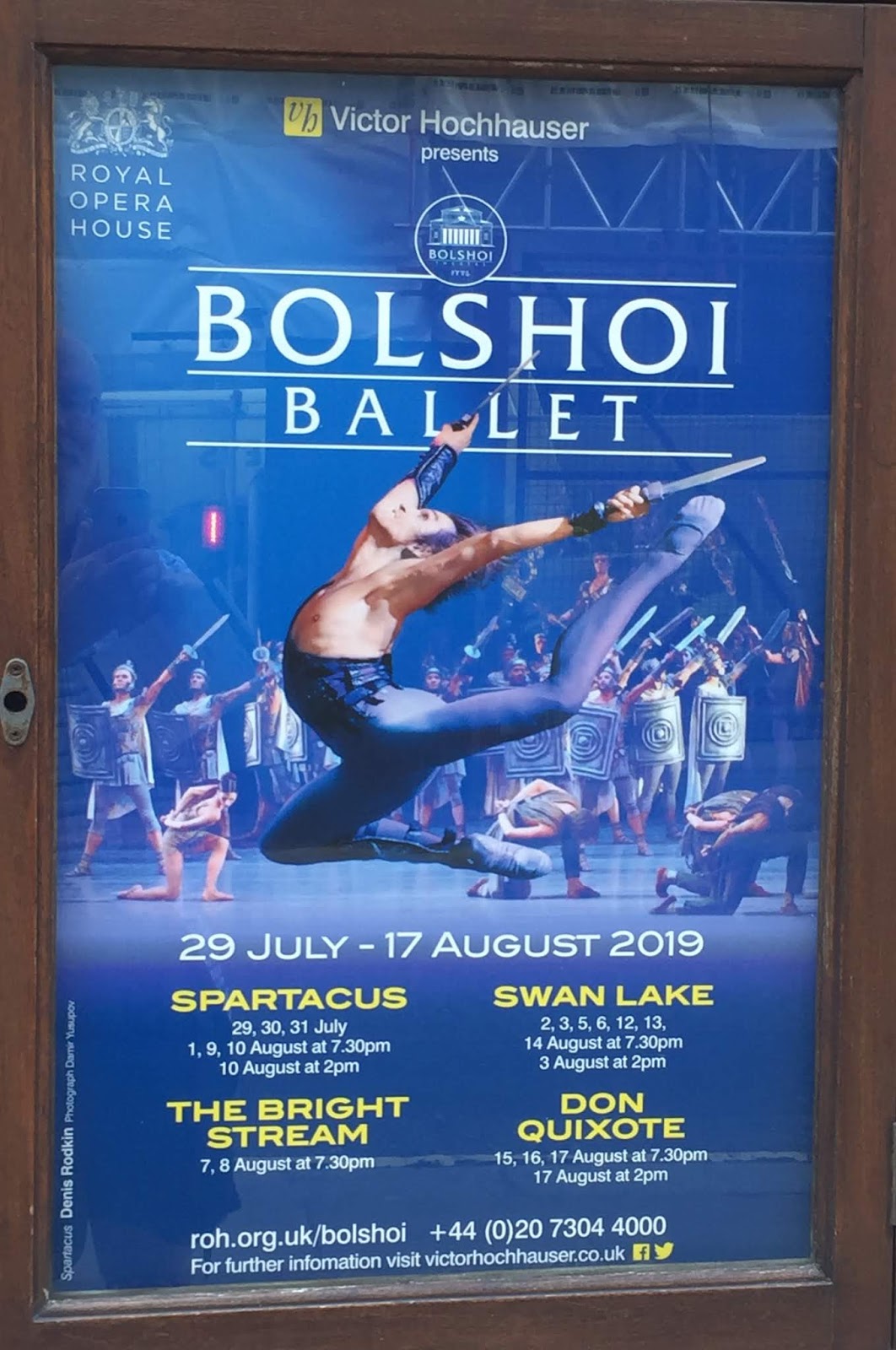
'Spartacus' by the Bolshoi Ballet at the Royal Opera House

Every couple of years the Bolshoi Ballet takes over the Royal Opera House stage to perform a short summer season of ballets from its repertoire. This year they're doing 'Spartacus', a ballet that had it's greatest success with its 1968 performances when student demonstrations swept across the world, the government of France was threatened by popular revolt and more serious revolt in places like Czechoslovakia. So what better tale to tell than that of the original Roman rebel?

'Spartacus' is by Aram Khachaturian (music) and Yuri Grigorovich (choreography) and was first performed in 1968 that made it popular and now a standard of Russian ballet. As with all ballets, it takes liberties with the facts of the story but that doesn't really matter since this is about love and war, freedom against slavery and grand gestures and spectacle. The staging is minimal but someone's obviously been playing with the rather spectacular and atmospheric lighting.

The ballet opens with the triumphant return to Rome of Crassus after his successful war against the pagans and there's  greta scene when he, basically, shows off and lauds it over the mere soldiers that won his victory, flashing his staff of authority all over the place and leaping into the air flourishing his sword. Yes, I get it, you won. Then, as an entertainment, he has Phrygia (Spartacus's wife) dance for him and has Spartacus fight and kill his friend. This is too much for our hero who starts a rebellion and the slave escape into the countryside of Italy.

Rallying his new army, Spartacus leads an assault on Rome and Crassus's estate to free the slave women, including his own wife. Cue an extended pas de deux between them to celebrate their love and reunion. It doesn't all go smoothly, however, and Crassus finds out where they're encamped and attacks, wins and traps Spartacus in a very dramatic scene where he ends up with dozens of spears in his chest lifting him off the ground as his life ebbs away. That image is repeated at the end on his funeral pyre when his followers hands mimic the spears reaching up to him as a hero - that's a very dramatic ending.


Phew! There's dancing and leaping, there's height and speed, romantic interludes and very masculine attacking dancing, it's all in there somewhere and, being the Bolshoi, there's some right old show off segments where the stars get to do their stuff. The last time I saw the Bolshoi I'd have said it was their 'B' team, that is, the dancers weren't fully synchronised and weren't their best, but this time the dancing was far better. This is what you'd expect from the Bolshoi.

The two male leads clearly had their own special skills - Denis Rodkin as Spartacus seemed to specialise in running leaps and Artemy Belyakov as Crassus did lots of spinning round and stopping dead still. We also had Eleanora Sevenard as Phrygia and Yulia Stepanova as Aegina, Crassus's courtesan. They were all technically excellent but strangely cold and not very engaging.

During one of the sword fights I couldn't help but compare them to the Royal Ballet, thinking of the Bolshoi as an early cubist painting by Braque and the Royal Ballet as a warm Titian full of colour and movement. I particularly thought of the sword fencing scenes in MacMillan's 'Romeo & Juliet', that premiered just a few years before this ballet, with the dancers leaping around in a synchronised sword fight with rapiers flashing and slashing at each other.  I don't know if 'Spartacus' is in the Royal Ballet's repertoire but I suspect their version of this ballet would be much more engaging. On the other hand, I'm probably biased in favour of the Royal Ballet whose stage the Bolshoi were dancing on.

So there you have it, the Bolshoi in London again and it's great to see a visiting company put on some of its signature dances, especially one I've never seen before. It was good to see the dancers and the production - and I can only admire Belyakov's ability to spin round and round and stop dead still on a pin. While aspects of the production were technically amazing I missed the warmth and passion I expected (and hoped) to see.

Wednesday, 26 June 2019

'The Firebird'/'A Month in the Country'/'Symphony in C' at the Royal Opera House

The latest triple bill of one act ballets at the Royal Opera House was 'The Firebird', 'A Month in the Country' and 'Symphony in C' - spectacle, narrative and pure ballet. What more could you ask for? I like the triple bills by the Royal Ballet since you always get a mix of styles and tempos, something there to suit everyone.

'The Firebird' was created for the Ballet Russe and, as such, is all about spectacle and that's we get. The Firebird flutters around the stage with grace moving to jerky, bird-like movements in her red and gold costume. The story is rather minimal and unlikely but you're not there for the story.

The prince eventually captures the Firebird but frees her as she gives him a magic feather to summon her when he's in trouble. That's just as well because he soon finds himself embattled by the local wizard and his minions so the prince pulls out the feather and, miraculously, there she is, the Firebird swopping round the stage destroying the minions. The prince is then free to marry a princess who was the wizard's prisoner and we get a grand finale with more and more people appearing on stage in lavish costumes as they attend the royal marriage. It's a spectacular scene with so many people walking on stage at the end.

One of the fun things was to see the background of a magical cityscape used in the final scene and recognising it from seeing an exhibition at the Victoria and Albert Museum in 2011 about Diaghilev and the Ballet Russe.


The wonderful Itziar Mendizabal danced the Firebird, Nehemiah Kish danced the prince, Claire Calvert danced the princess and Christopher Saunders was evil as the wizard.

'A Month in the Country' is based on the play by Turgenev and created as a ballet by Frederick Ashton. It's a regular in the repertoire of the Royal Ballet and is an elegant, narrative ballet, telling the story of the residents of the country house, the loves, the boredom, the everyday lives and the special. It was very well done and nicely staged and, after the spectacle of 'The Firebird', nicely changed the tone of the evening with its genteel dancing and muted colours. The lead character of Natalia was danced by a namesake, Natalia Osipova.

The final ballet was 'Symphony in C', a series of movements of pure ballet, not trying to tell any story, rather, just enjoying the sight and power of movement for its own sake. I loved the energetic dancing and the synchronised sections, especially when the stage was flooded by ballerinas in white tutus, creating an astonishing spectacle. There were a lot more ballerinas than male dancers who created a nice balance in their black tights and tunics.

The excitement mounted for me as more and more dancers joined the stage, groups of dancers coming together and separating, different movements and complex synchronised dancing. It was breathtaking. As the ballet advanced the stage was flooded with ballerinas in white tutus and it was a splendid sight, watching them create patterns on the stage and then breaking away before coming back to gather in synchronised perfection. I loved it! Another successful evening of very different ballets from the Royal Ballet.

Friday, 17 May 2019

Within The Golden Hour/Medusa/Flight Pattern at the Royal Opera House

This week we went to see a triple bill of one act ballets danced by the Royal Ballet at the Royal Opera House: 'Within The Golden Hour'. 'Medusa' and 'Flight Pattern'.

I've seen Christopher Wheeldon's 'Within The Golden Hour' before and this time it was just as mesmerising with its series of ensemble dances and duets, constant movement only slowing down to give you a chance to catch your breath. This time the dancers were in matching sparkly outfits which, I think, enhanced the performance. The repetitious and constant movement, the quick changes from one scene to the next and the excellent music all serve to draw you into the dance. Favourite dancers Sarah Lamb, Lauren Cuthbertson and Alexander Campbell all helped to lead the small troupe of dancers.

The second ballet was a new one and this was its third ever public performance, 'Medusa' by Sidi Larbi Cherkoui. It tells the tale of Medusa, a priestess of Athena who loves Perseus but is seduced by Neptune, cursed by Athena and then killed by Perseus. Not a happy tale. Enjoyable as it was, and with some excellent dancing, this ballet didn't quite work for me and I felt the staging and dramatic lighting sometimes seemed to over-shadow the dance. It'll be interesting to see what changes are made when it's revived in a few years time.

The final ballet was Crystal Pite's astonishing 'Flight Pattern'. I saw this ballet on its first run a couple of years ago and, when it was announced that it would feature in this season, it was the main reason for booking tickets. It's an incredibly powerful piece about forced migration, people fleeing their homes for their lives and seeking a safe haven. Virtually the whole piece is made up of a mass ensemble of dancers moving together, repetition and repetition, the huddled masses in grey all moving together, slowly but surely, with sometimes one or two dancers breaking away and taking a step forward or backwards, but always dissolving again nto the mass of dancers. The movement is relentless and powerful with messages of sorrow, hope and death and the survival of the human spirit. It's very contemporary, of course, and I think should be televised at some point to bring the tragedy of forced migration into our living rooms. There were 36 dancers on that stage led by Kristen McNally and Marcelino Sambe. Well done people.

This was a very successful evening and my favourite was 'Within The Golden Hour' for its joy and energy but 'Flight Pattern' will remain in my memory for a long time since it was staggeringly powerful and is an astonishing piece of work.

Friday, 19 April 2019

'Romeo and Juliet' at the Royal Opera House

Kenneth MacMillan's 'Romeo and Juliet' is a staple in the programme of the Royal Ballet and it's rather special to me. I saw Steven McRae and Iana Selenko dance the title roles three years ago and that production made me finally 'get' ballet and fall in love with it. O yes, it's that personal to me. I saw the John Cranko version of 'Romeo and Juliet', choreographed a few years before MacMillan's, when I was in Boston last year danced by the Boston Ballet at the Boston Opera House and thoroughly enjoyed it, but I prefer the MacMillan version.

The ballet is back in the programme for this years' season at the Royal Opera House so, naturally, I bought tickets. Steven McRae was due to dance the title role again but sadly injured his knee so our lovers were Akane Takada as Juliet and Ryoichi Hirano as Romeo. I've seen Akane dance in 'Manon', 'Mayerling' and as the swan in last summer's glorious version of 'Swan Lake' and seen Ryiochi dance in 'Nutcracker' and in 'Frankenstein'. They both have excellent track records. There aren't any production photos of them dancing the current roles, unfortunately.

We all know the story. Romeo Montague is a lad about town, stirring up trouble with the rival house of Capulet and hanging out with the Happy Strumpets in the marketplace, and then, after blagging their way into a Capulet masked ball to show off Juliet they see each other and fall in love. That starts the tragedy - how can the young lovers from rival houses possibly marry? They marry in secret and share one night of love before Romeo must run and hide since he killed Juliet's cousin, Tybalt, in revenge for the cousin killing Romeo's best friend, Mercutio. Juliet's parents press her to marry the hapless Paris so she feigns committing suicide. And Romeo, ah if only he'd waited another few minutes.

It's a tale of love and joy and tragedy and along the way we meet other characters in Verona. We meet Mercutio, Romeo's best mate and great sword-fencer. We see the Montague (white tights) and Capulet (red tights) gangs sword-fencing in the marketplace and end up with a pile of dead bodies so that the Prince of Verona has to intervene to stop them. This is proper fencing too, fully choreographed of course, but it's very exciting to see all the lads slashing at each other and jumping and bouncing all over the place! Sadly Mercutio and Tybalt also fence later in the ballet and Mercutio is slain, stabbed in the back by Tybalt so Romeo takes swift revenge.


We also meet the Happy Strumpets - the cast list rather casually calls them 'Three Harlots' but I prefer my name for the three lasses. Lead strumpet was a surprise to me - Itziar Mendezibal! I've seen Itziar dance several times, always with so much grace and poise and she was fabulous as Paulina in 'The Winters' Tale' a couple of years ago so it was lovely to see her in a more knock-about role teasing Romeo and the others with her undoubted charms. Romeo is no longer interested after he's met Juliet but I'm pleased he knew the Strumpets.

There is a gorgeous range of dancing in this ballet, from the energetic sword fencing scenes to the joyous pas de deux of the love scenes and our leads did themselves proud. Akane was great as Juliet, so elegant and graceful, moving from being the child at the start of the ballet to the poised young women of later scenes. Ryoichi also did great dancing, spurring on his comrades in trouble-making and worshipping Juliet. But, for me, Steven and Iana remain the definitive lovers - Akane didn't quite capture the child at the start and Ryoichi didn't have the same level of characterisation as Steven (but, to be fair, he didn't have the same time to practice the role). I also really liked James Hay as a very bouncy Mercutio and Bennet Gartside as Tybalt. It's a masterful ballet and a great production and odd to realise that this was MacMillan's first full length ballet - he was truly inspired when he choreographed it!

If you want to try out seeing a full ballet you could do a lot worse than choose this one. It's playing until June and will be broadcast live to cinemas on 11 June - try it? You never know, you might actually like it!