Tuesday, 5 March 2019

'Waitress' at the Adelphi Theatre

'Waitress' has transferred from Broadway to the West End, to the Adelphi Theatre on the Strand and it's a very nice feel-good tale about pies, domestic violence, pies, customer service, pregnancy, baking, illicit affairs, lots of sugar and spices, and, of course, sex. With songs thrown in for good measure. It's also about love and friendship and it made me smile. Oh, and did I mention pies? In these days of Brexit and Trump we can all do with a smile.

It's the tale of Jenna, our heroine, who is not only a waitress in Joe's Pie Diner but she bakes all the pies as well. She's clearly a nice person since she chats to and listens to Joe, the elderly owner of the diner who comes in every day for breakfast. We learn that she's become pregnant and is married to Earl, a universally unpopular man and there are signs of domestic violence to keep Jenna under control. He takes all her tips at the end of the day. She learns about a pie-making competition that could make her enough money to leave her husband and she also falls for her local doctor and they start an on/off affair. Months later and she has the baby, tells her husband to go away and leave her alone, now that she's empowered by the baby, but what about Joe and the diner? You'll just have to see it for yourself to see the ultimate ending.

It's a very American show in some respects but no less enjoyable. Do we have an equivalent to the diner waitress thing? I don't think so, but if you've been to America you'll have experienced it and you've certainly seen it in films. One moment I did find odd was when the doctor says there are ways to approach a pregnancy and Jenna blurts out that no, she's having the baby, without any mention of abortion. That's a dodgy topic in America so the author is playing it extra-safe given that those lines didn't even need to be said.

There are, of course, several sub-plots to keep us occupied, like Becky (waitress friend 1) having a secret affair with Cal (diner manager) and Dawn (waitress friend 2) marrying Ogie and these all have their own special scenes and laughs. In a way, that's what this musical is - it's about friendship and laughter, love and baking. What more do you need? There are a lot of songs in the show, very much current country tinged pop music that work really well and sound of now.

I thought Katherine McFee was excellent as Jenna as were Marisha Wallace and Laura Baldwin as Becky and Dawn respectively, great comic timing as well as great voices. I also like Stephen Leask as the diner manager who ends up having a rather raunchy affair with Becky. All in all, they make a great cast and it's a great show - if you need your spirits lifted you could do worse than go to see 'Waitress'.


PS: More pie for sale in the interval would've been welcomed...

'Nine Night' at the Trafalgar Studios

We were lucky enough to catch one of the last performances of 'Nine Night' at the Trafalgar Studios, the play that transferred from the National Theatre into the West End. Nine Night is the Jamaican tradition of holding a dead person's wake over nine nights with parties, lots of drinking and eating, reminiscing  and setting the spirit of the deceased free. Surprisingly, this is the first play from Natasha Gordon and it's been a tremendous success with some great writing and plotting. While I won't pretend to have understood all the Jamaican references in the play it was pretty obvious from the reaction of the element of the audience with Jamaican heritage what was going on. It's about death and a wake but it's also incredibly funny and heartbreaking.

It's a Windrush generation tale of Gloria who leaves her eldest daughter with her grandparents to come to London to make a new life, marry, have children and send for her daughter who never arrives. In old age Gloria gets cancer and dies and it's left to her British family to follow the Nine Nights tradition of her homeland. The tale is really about Lorraine, the British daughter who gives up her job to nurse her ailing mother and then the burden of Nine Nights falls on her to arrange. supply and manage. We gradually learn about the family, its ups and downs, family tales and traditions, how brother Robert suddenly needs money and wants to sell the house, Lorraine giving up her job, Lorraine's daughter Anita learning about her heritage and lots more. There are enough plot twists in here to keep anyone happy. And then the eldest daughter, Trudy, arrives from Jamaica and everything changes.

I laughed out loud, I sympathised, I cringed inside at the embarrassing bits, all the things you do with a family at its rawest. This was an excellent piece of writing made even more special by Natasha , the author, taking the role of Lorraine (she didn't play it at the National Theatre). The cast were excellent and I particularly liked Natasha, Oliver Alvin-Wilson as brother Robert and Michelle Greening as scary sister Trudy. The run has now closed but when (not if) it's revived I'll be in the queue to get tickets.

Monday, 4 March 2019

'Follies' at the National Theatre

I saw the revival of Steven Sondheim's 'Follies' at the National Theatre in 2017 (see here for that blog) and it was so successful that the production has been brought back with many of the original cast. It's a big show and isn't performed that often so it's nice to have the opportunity to see it again. It's back on the big Olivier stage with the same sets and staging but there are some small changes and it's these I'll focus on here.

The key changes are the addition of Joanna Riding and Alexander Hanson as Sally and Ben (replacing Imelda Staunton and Philip Quast) and the addition of Harry Hepple as the young Buddy. We also had Felicity Lott temporarily replacing Josephine Barstow as Heidi, the operative Weismann Girl. At first, it was odd seeing Joanna in Imelda's place but I gradually warmed to her in that role - it must've been a big decision (as well as a big opportunity) to step into Imelda's shoes but I think she did it quite successfully. It was also good to see Alexander again and he worked well with Janie Dee as his stage wife.

One of the most noticeable changes for me was to see the 'ghosts' of the past shadowing the 'current' selves throughout the performance. Whenever Sally or Phyllis or any of the cast were on stage they were clearly shadowed by their younger selves in full costume.  I really liked this link between the 'now' and the 'then' that they are all nostalgic about in a ruined theatre about to be turned into a car park.It worked really well.

It was nice to see Dawn Hope and Tracie Bennett belt out their show-stoppers (which is exactly what they are). Janie Dee was also on top form. Surprise of the evening went to Joanna Riding singing 'Losing My Mind' (which she is clearly doing) by downing a handful of pills (not really) and pulling off her wig on the final note of the song. That was a big wow moment.

Well done all, a great re-creation of the production that was a joy to see again. If you're in London you could do a lot worse that get tickets (if you can) to see this show.

Monday, 18 February 2019

'Don Quixote' Rehearsal at the Royal Opera House

On Friday I went to see a rehearsal of the Carlos Acosta choreographed 'Don Quixote' with the Royal Ballet at the Royal Opera House. I quite like going to rehearsals since the tickets are ridiculously cheap, the show is fully staged (other than the band being in mufti) and you know you're there with real ballet enthusiasts. I've seen the traditional Petipa 'Don Quixote' danced by the Bolshoi a few years ago and, although I enjoyed it at the time, the memory hasn't lingered. I thought I'd give it another go and see the Acosta version and I'm so pleased I did.  

It's a gorgeous production (also down to Acosta) with lovely sets, lighting and costumes as well as great energetic dancing and continual movement on the stage. From the rather dark prologue the stage was suddenly bathed in incredibly warm light reflecting the sunlight of Spain as the cast throng the stage and mill about as dances start and the story starts to unfold. It was terribly exciting and made me want to see more and more and where was the good Don?

Ah, that's the thing. Don Quixote is an old man and Sancho Panza is fat and middle aged so who does all the dancing? The young folks, of course, so the story isn't so much about the good Don but more about him enabling a story to progress. That story is the love between Kitri and Basilio and, after many adventures, he helps them to get married even though Kitri's father wants her to marry a local nobleman. It doesn't take long to realise that the good Don is an old romantic at heart that is on a quest to find his own love, the mysterious Dulcinea.

Sadly I don't know if the good Don finds his love or not since the Royal Ballet didn't dance Act Three. After the opening dance of Act Two the curtains closed and we were evacuated from the building due to a fire being reported somewhere in the building. After we got out, waited in the street and then got in again since it seems that the fire (if there was one) had been dealt with, we'd lost about an hour so there was only time available to dance Act Two.

That was disappointing but I'm so glad to have seen it - our lovers and the good Don meet with a band of gypsies in the countryside and we're treated to some marvellous flamenco dancing. Afterwards the Don attacks the evil windmill, gets knocked out and has a fever dream seeing the Dryads dance and that sequence was so beautiful to watch as the stage filled with ballerinas in tutus all dancing together in synchronised movements. Then we had to say goodbye since the Royal Opera House needed to get ready for the evening's performance.

Kitri was danced by Yasmine Naghdi  and Basilio by Marcelino Sambe, with Matthew Ball dancing the famous matador and Beatriz Stix-Brunell as the street dancer. The romantic old fool, the good Don, was played by Christopher Saunders and Sancho by Philip Mosely. I want to see the whole thing again - including Act Three - so I've booked tickets to see it when it's broadcast live to cinemas on Tuesday this week. Most of the run is sold out or only has random seats available and I don't want to wait until April to see how this production concludes in Act Three.

Thank you Mr Acosta for breathing new life into a glorious story with amazing dances and opportunities for those young folk to shine.

Saturday, 16 February 2019

'Violet' at Charing Cross Theatre

It's been a good year for Jeanine Tesori who wrote 'Violet' which is on at Charing Cross Theatre while another of her shows, 'Caroline, or Change' is playing down the road at the Playhouse and just six months after another of her shows, 'Fun Home' was on at the Young Vic. It's clearly her time in London.

'Violet' is based on 'The Ugliest Pilgrim' by Doris Betts, a short story telling the tale of a young woman who travels by bus across America to get a prominent scar on her face magically repaired by a charismatic preacher. It's set in 1964 with the racism of the time and on her bus journey we meet several of her fellow passengers including two soldiers, on black and one white, who she develops relationships with. There are flashbacks to her as a young girl with her father and we find out that he gave her the scar in an accident with his axe. We follow Violet's adventures as she travels across country until she reaches the preacher but can he heal her? And what actually needs to be healed?


I quite liked the structure of the work, a bit picaresque moving from one set scene to another courtesy of the motif of the bus and the journey. What didn't work terribly well was the character of Violet, the heroine who should be sympathetic but I found her a bit too militant, too sure of what was she was doing and what the outcome would be - a bit of self-doubt would have helped a lot, I think.

Kaisa Hammarlund was good, if a little bit turbo-charged, as Violet, with an excellent voice and she delivered the songs really well, especially her quiet song to her soldier lover as he falls asleep after their first night together. I also liked Jay Marsh as the soldier who falls in love with Violet but, sadly, isn't the soldier she sleeps with.

I think my main problem with the show is that I couldn't remember any of the songs, even while walking to the tube station. They sort of oddly work while watching the show but aren't sufficiently memorable. A musical ought to have a few songs you go home humming. I wasn't humming anything.

Painted Frames

There's space in the Plastic Bag for everything - it's a big bag after all - including a record of picture frames I've painted. The frames are bought but then painted and varnished by me. Most have been given away but I want to keep a record of the various frames in one place, rather than random photos on different bits of social media, so here it is.

I painted the first frame because I wanted to frame a small watercolour painting I'd done on a course last summer. I wanted a black mount and then a multicoloured frame to match the painting and, of course, that's something I couldn't get so I thought I'd paint my own. Getting my acrylics out I started splodging on the colours, all the colours I had in a random fashion. Acrylics dry darker than when they are wet but adding gloss varnish made them shine.


I enjoyed painting the frame and wanted to do more. I got a couple of small wooden frames and thought I'd try out the splodgy approach again but in a more controlled way, using variations of one colour and those either side of it on the colour wheel. So I did a red one and a blue one.


Then I wanted to do something different and, to coincide with a little old lady's birthday, decided to do a floral frame as a present. I mulled over doing a range of different flowers around the frame, with cutting out a flower template to make them identical, with making it look like a posy of flowers. Then I decided I was over-complicating it and it was best to keep it simple so I painted very simple flower shapes, painted the background green and then started adding more detail to the flowers.


I have a lovely, colourful bowl I bought in Barcelona a few years ago which is decorated with sun images so I thought I'd use that as the basis for another frame.


I decided that Christmas presents would be handmade this year so I got some lovely ridged frames and painted them in the mixed colour approach I'd used in the summer. I did two frames and painted them in different shades of blue shading to purple on one side of the colour wheel and green on the other side.


More recently I've used that same approach to paint another ridged frame, a bigger frame, but this time basing it on purple, shading to blue on one side and red on the other.


Much as I enjoy the mixy approach, and I like the effects you can get by mixing colours and using the brush to leave a sort of feathered effect in places, I can't keep doing the same thing. So I played around with different designs and colours and drew out a load of different ones in my sketchbook and settled on one I'd done with stripes of colour on a plain background. That made me think of paintings by Piet Mondrian so I think of this as my Mondrian frame.


For this frame, I also experimented with the acrylic paint by adding a gloss medium to the paint rather than water so see what effect that would have in bringing out the colours. It certainly makes the colours bolder and more vibrant. Adding the varnish really makes it zing.

I'm not sure what to do for my next frame but I think I'll have a break before starting another one. Watch this space...

Wednesday, 13 February 2019

'Vienna 1934 - Munich 1938' at the Rose Theatre, Kingston

On Saturday we went to see the third and final performance of a play written and directed by Vanessa Redgrave at the Rose Theatre in Kingston. It was billed as 'a work in progress' so we knew this wasn't finished product by any means, it was an acted reading to try out the piece in front of an audience. Vanessa came on at the start to begin chatting to the audience, introduce the piece and give us some background to it, to the family friends featured in the work and some of her own memories of the war when she was a child.

The play's theme is the rise of fascism in Europe and the nazis in Germany in particular. There's a lot going on in the play - and I think that is one of it's problems, it needs to be simplified - but I thought of act one as being about Stephen Spender, act two about her dad Michael Redgrave being gay, and act three showing how fascism spread to Italy and a long speech delivered by Thomas Mann after he left Germany (her dad was a fan of Mann).

Although it didn't really hang together as a play there were some fascinating insights into the characters and the thinking at the time. It was all based on journals, news reports, diaries and autobiographies of the people involved, often with personal photos of them projected on the back of the stage. This is clearly a labour of love and Vanessa has put a lot of work into it.

In the evening there was an interview with Vanessa and a Q&A which we also attended and it was lovely to just hear her talk and reminisce. At one point there was a short film about her from the late '60s/early '70s showing us radical firebrand Vanessa marching under banners, being chased by the police and with Tariq Ali. It was an extract from a film her husband pulled together for her 80th birthday. The most pertinent piece of the segment was when she went up to receive her Oscar in 1978 and she reiterated her dedication to fighting anti-semitism and fascism. That's what the play had been all about. All these years later and she's true to her word. Well done Vanessa,

Monday, 11 February 2019

The Alte Pinakothek in Munich

I visited the Alte Pinakothek in Munich to see its great 'Florence' exhibition so, while I was there, I needed to look round its collection, up the long, long staircase to the first floor. It's Florentine Renaissance paintings were downstairs in the exhibition so I was expecting gaps in the collection but it was still surprisingly good and the rooms were mainly surprisingly empty of visitors - I was the only one in some rooms - since everyone was downstairs in the crowded exhibition.

The first few rooms were interesting enough with large early northern paintings, all rather similar in style and content. But it pays to keep your eyes peeled since I found this lovely little painting of the 'Tower of Babel' by Lucas van Valkenborch, a copy of the painting by van Eyck. I quite like the idea of copies being in museums in their own right as works of art. It's very small and easily missed.  Further along were large paintings of the Virgin Mary and John the Baptist, also copies of van Eyck, this time from panels in the Ghent Altarpiece. They were really good, almost life-sized and quite jewel-like to see (my photo doesn't do them justice).  They were painted by M van Coxie in the mid-1500s.


Keep walking and you'll find paintings by Lucas Cranach, quite a few by Rogier van der Weyden, Hans Memling and others - it's almost a who's who of northern Renaissance painters. The northern painters used oil to mix their paints well before the Italian painters and their paints still glow with colour and life as they strove for ever greater realism and accuracy in their paintings. Here's a rather lovely 'Adoration of the Magi' scene by van der Weyden. There are many great paintings from the northern Renaissance and it was difficult to choose just one and I picked this for the colours. It was painted in 1455 and it's a tribute to him and his workshop that the colours remain so vibrant.

Then you come across one of the most wonderful paintings in the collection, a self-portrait by Albrecht Durer, resplendent in his expensive coat and his carefully coiffed ringlets. What a dandy and what a handsome man he was. My photograph is awful and has caught too much light but trust me, this is a beautiful painting and one of the highlights of the collection. By any standards, Durer was a great painter and a great draughtsman and he did this painting when he was only 28. To give it its full title, this is 'Self-Portrait with Fur-Trimmed Robe' from 1500. It's inscribed with the words in Latin, "I, Albrecht Durer of Nuremberg, portrayed myself in appropriate colours aged twenty-eight years". Is this a tribute to overwhelming vanity or is this an advert that says, 'give me a commission and this is what you'll get from me'. I suspect the latter. It really is an astonishing painting.
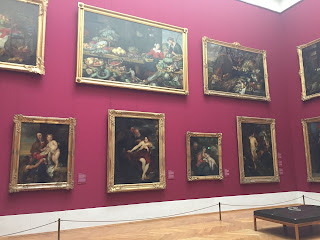

Moving forward to the end of the 1500s we come across loads of astonishing paintings by Rubens. Painting after painting - he was obviously a favourite of whoever developed the collection. I really need to do some work on Rubens one of these days.

There's a great painting of the 'Drunken Silenus' (there's a different version in the National Gallery in London which I prefer), a portrait of Rubens and his wife as a wedding portrait (and they made a handsome couple indeed), but the painting that stopped me in my tracks was 'The Death of Seneca'. It's an astonishing painting in which the teacher of stoicism accepts his fate and commits suicide. The body is based on a classical statue Rubens drew in Rome and the head and face are based on a bust of Seneca. I was browsing round the paintings, this one's a Rubens, that one's a Rubens and then I saw this and stopped dead to gaze at it. What a powerful painting, almost life-sized and very difficult to ignore. A moment in time captured by Rubens forever in incredible detail.

Another painting that stopped my perambulations was 'Two Satyrs'. Just look at that satyr in the front and tell me he's a saint in disguise. No, *that* satyr understands getting drunk and rutting with whoever is around and will enjoy it immensely. From the look of him he's just been very naughty and plans to be naughty again quite soon.


But let's not forget that Rubens is also justly famous for his religion works and this crucifixion caught my eye. Just look at those arms being stretched and pulled down by the weight of the body, putting more pressure on the nailed feet. A very simple and very effective composition to meditate on.


There are, of course, many more great paintings than I can cover in this short blog about the museum, but I'm pleased I took the time to explore it. I was visiting to see the 'Florence' exhibition (one of the best I've seen in a long time) and I was almost expecting the collection to be rather provincial with the truly great works being in the Gemaldegallerie in Berlin, but I was wrong. There are more than enough great works to keep any art lover happy in the Munich Alte Pinakothek. I hope to visit again one day.

And then down, down, down the stairs to the ground floor...

Sunday, 10 February 2019

'Asphodel Meadows'/'The Two Pigeons' at the Royal Opera House

The current double-bill of ballets at the Royal Opera House is the one act 'Asphodel Meadows' and the two act 'The Two Pigeons', an interesting mix or an abstract and a narrative ballet. I like the double and triple bill programmes the Royal Ballet performs since they're a great opportunity to see different styles and dancers on the same evening. I've seen 'The Two Pigeons' before (with Steven McRae dancing the lead) but 'Asphodel Meadows' is a new one for me.

According to Wikipedia, Asphodel Meadows is the part of the ancient Greek underworld where ordinary go when they die. I've got no idea if that was in Liam Scarlett's mind when he choreographed the ballet but I suspect it might have been when, as the ballet opens, three dancers walked slowly backwards to the centre of the stage to begin the dancing. We see solo's, duos and groups dancing, ever changing and mixing up the pace, creating a strange vision in an abstract dance.

At one point, during a particularly jerky sequence, I was reminded of the 'Choreography' piece in 'White Christmas' while Danny Kaye sings about 'chaps who did taps aren't tapping anymore they're doing choreography'. But, you know what, I loved this short ballet in all it's weirdness and sometimes disjointed movements, it drew me in and made me wish it was longer than its 25 minutes. It was very elegant and I hope to see it again one evening.


'The Two Pigeons' is a more traditional ballet by Frederick Ashton with a straightforward story of young lovers. It opens in a Parisian artist's garret with a young artist painting his beloved who can't stop fidgeting. He's already feeling frustrated when his girlfriend's friends arrive so, when he sees a troupe of gypsies he invites them in as well and that's when he sees a beautiful gypsy girl. He's enchanted and leaves his girlfriend to run off to the gypsy camp to see his new girl. The girl's lover fights him (in dance form, of course) and he loses and is kicked out of the encampment. While walking home a pigeon lands in his arms and he takes it home with him. He makes up with his girlfriend and then a second pigeon flies into the garret as a lovebird. The end. So, not the most complicated of plots but, as ever, it's the dancing that matters.

Lauren Cuthertson danced the girlfriend as a playful and elegant young woman, very precise as always. The dancing was very pretty and delicate but I think I preferred the passion of the gypsy girls' dances and leaps and almost aggressive approach to dancing. I can quite understand the artist running off to the gypsy camp to escape the borderline annoyances of his girlfriend.

Of course, the gypsy girl turns out to not be very nice at all, taunting and teasing him during the fight with her lover so it's a hard lesson for the young artist. He goes home with his tail between his legs while his soppy girlfriends mourns the loss of love only to regain it a couple of minutes later.

I liked the playfulness of some of the dancing and Lauren was great as ever but, you know what? I preferred 'Asphodel Meadows' with its abstract patterns and dancing that kept my attention at all times. Well done Royal Ballet people!