Sunday, 9 September 2018

Emil Nolde at the Scottish Museum of Modern Art

The two big exhibitions in Edinburgh at the moment are about Rembrandt and Emil Nolde and, with limited time, I chose Nolde. And I'm so pleased that I did. Rembrandt is brown but Nolde is every colour of the rainbow and a few more and that's why the exhibition is titled 'Colour Is Life'. Colour is, indeed, life and we need more of it, as the sandstone front to the gallery clearly shows.

The exhibition presents works from across Nolde's life and I was pleased to see that one of the constants was his paintings of plants and flowers, from the early paintings of his gardens to later paintings of poppies. Such gorgeous colours and compositions. Paintings of parties and nightclubs in Berlin in the '30s, showing the colour and glamour and the decadence. And paintings of his trip to the South Seas and the tropical vegetation and peoples and his return to Europe during the First World War. There's a lot going on in these works.

It was odd to read about his life alongside his paintings and see that he lost thousands of his own works along with those he'd collected by Klee and Kandinsky when his Berlin apartment was bombed in the Second World War. Who knows what we're now missing? It was also disturbing to read of his support for the Nazi Party which was offset by his being banned from being a painter and having more works than anyone else exhibited in the first 'Degenerate Art' exhibition. Since he was banned he found it difficult to buy canvasses and oil paints so he honed his skills with watercolours and paper and produced some astonishing works. I'm new to painting with watercolours and don't understand how he produced such deep colours in the medium. I need to experiment more, obviously.

To illustrate Nolde's anti-semitic support for the Nazis the exhibition includes a painting in a room of religious paintings (rather than political paintings) of Jewish elders gloating over the crucifixion. The museum even has a paragraph on its website warning about this painting and saying it doesn't support the views expressed in the painting. I won't show the painting here but it's pretty obvious what it's about. His saving grace is being banned by the Nazis, I suppose. Instead, here's a painting of Adam & Eve after the fall. I'll stick with the colour and inventiveness of his paintings.

One of the last paintings on display was a small watercolour of a skater which really caught my eye. The strange composition with extreme foreshortening, arms behind his back and clear movement, all off which show athleticism and thrusting his way forward on the ice. That muscular body growing out of the touch of skate to ice and the bulging shadow, such a great composition in such minimal colours.

There was also one late painting of poppies, presumably from his garden, in the exhibition, and plastic poppies for sale in the gallery shop (I didn't buy any). I like his paintings of poppies and have used his paintings as the basis for my own versions of his poppies..

The Museum is about 45 minutes walk from the Scottish National Gallery so you need to want to go there rather than just drop in on your way to somewhere else but this exhibition is worth it. I'd be quite happy to see it again if it transferred to London.  

'The Humans' at Hampstead Theatre

Last week we went to see 'The Humans' at Hampstead Theatre. This is the play I saw in a touring version in Boston back in March this year with the last of the winter snow piled up outside the theatre doors. I was muffled up in a scarf and big coat but I was in sandals and shorts to see this version which was played by the Broadway cast on a much smaller stage in Hampstead.

It's the tale of the Blake family's first Thanksgiving dinner at Brigit, the youngest daughter's new apartment in Chinatown in New York. Brigit and her partner have just moved in and haven't finished unpacking yet but they host Brigit's grandmother, parents and older sister for the traditional dinner. We see traditions and hear home truths, long-standing jokes and family niggles, the awkwardness of the new member trying to fit in (Brigit's partner) as well as the grandmother suffering from dementia. Transpose this to a Christmas dinner in the UK and you have the equivalent.

As soon as I saw the set showing two floors and a spiral staircase it all came flooding back from when I saw it in Boston. But this was a different cast, a cast that had worked together for a long time and lived the play in a different way and that was obvious after the first few minutes. Even though this was a preview, the cast gelled in a good way, they were a family already and acted like it, playing off one another. I particularly liked the relationship of sisters Aimee and Brigit, sharing cares and jokes, the religious mother Deidre and the stoic father Erik. They were very believable as a family with the little jokes and hurts that define families. I loved the way that Aimee's loss of her girlfriend is treated like any family break-up and the grandmother having dementia is just another trial thrown at the family by life. Neither are pointed at or made special in way and Erik, the father, consoles Aimee after an awkward phone call.

The writing by Stephen Karam is spot on and very naturalistic and the acting was excellent. I particularly liked Cassie Beck as Aimee, Jayne Houdyshell as the mother and Reed Birney as the father. The writing and the winning performances drew me in and made me a silent viewer to the family scenes I watched. I thoroughly enjoyed this production and might well go back for seconds later in the run. Go and see it if you can.

Wednesday, 29 August 2018

Edward Bawden at Dulwich Picture Gallery

I finally went to see the Edward Bawden exhibition at Dulwich Picture Gallery and I'm pleased I've finally seen it. I don't really know anything about Bawden but have bought some of his designs on cards in the past and that's it. I had a lot to learn.

Bowden seems to have done a bit of everything including film posters, adverts for the Tube, watercolour landscapes, book covers and illustrations, portraits as a war artist, lots of prints, Christmas cards for Fortnum & Mason, designs for menus for fancy restaurants... you name it, he probably did it. I had no idea that he was an official War Artist in the Second World War or that he was taught by Paul Nash. So much that I didn't know.

His early works seem to focus on commercial art and watercolour landscapes, some of which look like they include ink pen drawings. All of his works were on a human scale, not the large wall-sized paintings many of his contemporaries were starting to do. I always have a thing about big paintings - they're too big for the average wall so aren't aimed at you or me, but rather at rich people or corporations or public spaces. I prefer something that will fit on my wall thank you, and all of Bawden's fit that criteria.


I like that he seemed to do different series of works - markets in London, landmarks, gardens and such like. This one is Borough Market under London Bridge with Southwark Cathedral behind. He also did a great print of Brighton pier.


I liked his illustrations for an edition of Aesops Fables including the hare and the tortoise and the lion and the gnat. You've got to feel sorry for that poor Grrrr Lion squirming and suffering with the nasty gnat. He has a lovely touch for telling stories through his art - who needs words when you see the lion's eyes and see him squirming on the ground.

The exhibition is only on for another couple of weeks so see it while you can.

'The Lehman Trilogy' at the National Theatre

'The Lehman Trilogy' is a play in three parts, each about an hour long, that tells the story of the three brothers that built the Lehman conglomerate and their children and grandchildren on Wall Street from 1848 to 2008. It's a very narrative play - this happened, then that, then one of the brothers had this idea and then that happened, and so on. But, you know what? It really pulled me in so that I wanted to know what happened next. And for that, I largely put it down to the mesmerising first monologue by Simon Russell Beale that dragged me in and made me sit up and listen. I was very impressed with that.

There's a really powerful clarity to the piece, with the writer clearly picking and choosing events to back his vision for the play and that's part of its strength. I couldn't help but wonder if any of the descendants of the family had seen the play and what they thought about it?

The play opens with Henry Lehman getting off the boat in New York, a good Bavarian Jew who has learned to drink and gamble on his journey west, and who opens a store in Alabama. He's then joined by his younger brother and finally by a third brother. The shop prospers and they become cotton traders, inventing the role of middle-men. Henry dies but the middle brother. Emanuel, heads off to New York to open a trading office while Mayer stays in Alabama to run the cotton business. Both somehow survive the Civil War and build the business that comes to focus on trading different commodities in New York.

The next generation appears to take on their roles in steering the company and expanding it into new areas. Then their children appear to take on the company and take it through the stock market crash of 1928 and on through the decades, expanding into new territory like films and computers. Then the greedies appear after the Lehmans have been ousted from their own company and we head towards the 2008 world financial crash.

The play takes place within a rotating set that remains the same throughout, a modern office suite of an office, waiting room and conference room, glass walls and bright lighting. The backdrop was a giant screen for different projections and there are various piles of storage boxes to vary the set. I was't too keen on the set to start off with but when they started writing on the glass walls - signs for the shop, numbers dead in the Civil War - it started to win me over with its versatility and its promise of what was to come.

All the parts were played by the same three actors: Simon Russell Beale as Henry Lehman, Ben Miles as Emanuel and Adam Godley as Mayer. They played the female parts as well as their own children and grandchildren and wore the same frock coats throughout, occasionally turning up the collars. It was definitely a tour de force for each of them and so many, many words to remember. I was very keen on the whole thing and wanted to know what happened next, keen to get back in from the two intervals scheduled to break it up. The linear narrative kept my interest in wanting to know the next part of the story.

I suspect that part of the attraction of this tale is that it's the story of so many families of Americans - parent or grandparents or great-grandparents seeking a better life in America and most making it, though not to the extent of the Lehman brothers. I wonder how many Americans can trace their ancestry in America back to 1848?

The play was written by Stefano Massini, adapted by Ben Power, and directed by Sam Mendes with Es Devlin as the designer. The play really touched something in me that makes me pleased to have seen it. The endless words must've been a challenge to the three actors to memorise, especially for such a long play. Go and see it if you can, it's well worth it.


'Fun Home' at the Young Vic

Last week we went to see 'Fun Home' at the Young Vic, a new musical that won loads of awards on Broadway and has opened for a short run here. It's a rather strange tale based on a comic book of the author drawing her life story in comic form to help her come to terms with her family, who she is and her relationship with her dead father. She's a lesbian who only finds out that her dad is gay after she comes out to her family after going away to college.

The play opens with Alison wandering onto the stage to start plotting out the next instalment of her comic and that's when the flashbacks start and we're introduced to her younger self, her father and mother and two brothers. That sets the format for the play, with lots of flashbacks to different episodes of her life to try to shed light on what was really happening. We see three versions of Alison that I've categorised as eight years old, 18 years old and 28 years old.

Her mother and father are both teachers and the father doubles as the local funeral director (hence the title of the play). We gradually learn more about the father as he chats up former students to have sex with them and, on a trip to New York, leaves his children asleep in the hotel room so he can go out cruising. We learn little about her mother until near the end when she reveals her suffering over the years, coping with the police getting involved with her husband, her shame and loneliness, knowing that she's the optional extra in his life.

It's a musical so there's a song for every scene and the whole cast sing at different points. The three children perform a Jackson 5-esque song while playing around a funeral casket and the eight year old Alison sings a 'coming out' song after seeing a butch lesbian in a diner. One of my favourite songs was sung by student Alison after having sex with her new girlfriend for the first time, and how she tells us that her dissertation is going to be about her spine so she can examine it in detail and often. Young love, eh?

The main characters were the three Alisons and the father and I thought all the Alisons were very good - Harriet Turnbull as young Alison, Eleanor Kane as the student and Kaisa Hammerlund as the adult. The father was rather unsympathetic and charmless and played by Zubin Varla who was OK but didn't bring anything to the role to make him a bit more likeable. The mother was played by Jenna Russell whose only solo song was towards the end of the play when she explained her unhappiness to Alison while explaining that her dad was gay. It was really touching. Also a little shout out to Cherrelle Skeete as student Alison's girlfriend.

It's an interesting play and it was nice to hear the audience reaction at times as they recognised or related to some of the scenes. I'm very pleased that I've seen it but I can't actually remember any of the songs or have any great wish to see it again. Sometimes when I leave the theatre I know I want a second viewing but I was happy with one viewing of this play. It didn't really touch me and there was a hint of the 'sad life of the gay man' about it, the usual stereotype. On the other hand, realising - or rather admitting - that she was lesbian was a release for Alison, which was far more positive. Good on the Young Vic for putting this on. 

Sunday, 29 July 2018

'The King and I' at the London Palladium

We all know 'The King and I' by Rodgers and Hammerstein and we've all seen the film with Deborah Kerr and Yul Brynner and enjoyed them bouncing around the palace to 'Shall We Dance?'. But have you seen it performed live in front of you? It's just as magical and includes all those sequences we remember from the film. And why shouldn't it since it was a stage musical years before it was filmed.

It's the tale of Mrs Anna Leonowens who takes her son with her to old Siam to be governess to the king's many children and her sparring with the king over many things as he tries to modernise his country. And, of course, they fall in love and argue and nothing can happen of course because she is an English gentlewoman and he is the king. Because we need some passion we also have the young lovers from Burma to provide a second, supporting storyline. The play ends with Prince Chulalongkorn telling his father about all the reforms he will make as Anna sits by the king's bed and he dies. It was all very tender and gentle and I liked that the spotlight stayed on the new young king as the curtain came down.

It's a really good production imported from Lincoln Centre in New York and by the same team that put on 'South Pacific' in 2009. Coincidentally, the role of Ensign Nellie Forbush was originally played by Kelli O'Hara but she'd left before I got to see it in 2010. Kelli played Anna in the revival of 'The King and I' and we were lucky enough to have her transfer with the production to London, along with Ken Watanabe as the King. I'm very familiar with Kelli's voice from the 'South Pacific' cast recording and it was marvellous to see and hear her sing these iconic songs on stage in front of me.

Of course, being familiar with the film and the songs doesn't mean there were no surprises on the night. I wasn't expecting to hear 'Hello Young Lovers' at all, let alone so early in the play, with Kelli's voice soaring away as she tells us all about love. Such a pure and powerful voice and great delivery.

It was also good to see Ken Watanabe as the King and he and Kelli seem to gel nicely on stage, still fresh and energetic. I also liked Naoko Mori as Lady Thiang, head wife and mother to Chulalongkorn, who gave a very touching performance as someone who clearly loved her King and wanted the best for him.

It's an excellent production, great sets and sumptuous costumes, great lighting and choreography, an all-round success. It was also great to finally see and hear Kelli O'Hara. I'm so pleased I went to see it.

Saturday, 28 July 2018

Three Films

I seem to go to the cinema quite rarely these days. I see the big Marvel films like 'Black Panther' and 'Avengers: Infinity War' but that tends to be about it. So it was quite a surprise to find myself seeing three films in three weeks about three people.

'The Happy Prince' is the culmination of Rupert Everett's love affair with Oscar Wilde and tells the tale of what happened to Wilde after he was released from Reading prison and went to live in exile on the Continent. I saw Rupert Everett play Wilde in 'The Judas Kiss' a few years ago and that production apparently helped to get this film off the ground. With all the production agencies, producers and assistant producers in the credits at the end, he's obviously put in a lot of work to raise the finance to get the film made.

Rupert not only plays Wilde but he also wrote and directed the film, clearly a labour of love. The film took a little while to get going but it was worth it and I loved bookending various episodes in Wilde's life  by him telling the story of 'The Happy Prince' to a couple of street urchins.

'McQueen' is a documentary about the short life of Alexander McQueen and his rise to prominence in the fashion world before his death at the age of 40. The film is a thing of beauty in itself, very elegant and measured. There is lots of footage from the time as British fashion took off in the '90s, with clips of Isabella Blow and others who were all at the centre of it with McQueen.

There was also footage of some of his spectacular fashion shows and a gob-smacking moment when robots open fire with paint onto a beautiful, pristine white dress the model is wearing. That was a wow moment and I preferred the dress after the paint job (such clever robots). The thing that was missing for me was the lack of explanation or exploration of what went wrong to rob him of his joy - drugs are mentioned and there's footage of McQueen speaking about cocaine, but nothing about what set him off on that path. The film ends with his suicide the night before his mother's funeral - all that creativity snuffed out by success and money. If you get a chance to see the film then please do so, it's well worth seeing and is beautiful in its own right.

'Carrington' is a film from the '90s about the artist Dora Carrington and her love for Lytton Stratchy. That puts her into the Bloomsbury group of artists. She was a star pupil at the Slade School of Art before the First World War alongside Stanley Spencer, Paul Nash and others. She wasn't bothered about exhibiting her work, she painted because she wanted to paint for herself and for Lytton and that's probably why she isn't more well known. The film was screened as a one-off at the National Gallery.

Carrington is played by Emma Thompson and Lytton by Jonathan Pryce and it's a strange and touching tale of their platonic and deep love for each other, having their own lovers but always coming back to each other and sharing their joys, tears and lives. It ends with Carrington's suicide after Lytton dies.

Three films about three people, all artists, all dead while still young (Wilde was 46, McQueen was 40 and Carrington was 39) and all have left their own legacy. There's currently a year-long season of Oscar Wilde plays in the West End, the V&A put on the big exhibition about Alexander McQueen a couple of years ago so what we need is a big exhibition of Carrington's works. She was prominent in 'The Crisis of Brilliance' exhibition a few years ago but it's time for a proper retrospective exhibition - yes, Tate Britain, I'm looking at you.

Friday, 27 July 2018

Theatre Compendium II: 'An Ideal Husband', 'Swan Lake' and 'Hamlet'

Another compendium of things what I saw in June, this time Oscar Wilde, the glory that is the Royal Ballet and 'Hamlet'.

'An Ideal Husband' at the Vaudeville Theatre

The Oscar Wilde season continues at the Vaudeville with 'An Ideal Husband'. It's always fun to see an Oscar Wilde play, especially when it's well produced like this season is, but we've sort of seen it before. It's another morality tale of the upper-class high-minded wife and the not so high-minded husband, the problems with their friends,  deep secret that must never be spoken of that somehow comes to light and the inevitable fall-out of that secret becoming known to a few more people.

There are, of course, all the shenanigans that need to take place to make the play enjoyable and make the audience laugh at (not with) the characters with Wilde's authors voice coming through loud and clear at times. He is rather forensic with his digs at Victorian 'society' and morality and I suspect he would've been more scathing if he thought he could get away with it.

I really liked this production and even laughed out loud a few points (a rarity for me) but two things spoiled it - the Foxes, Edward and Freddie. Fun as it was to have a real father and son play the father and son, I just have to wonder if they were the right father and son. Edward's been around forever and knows his stuff but his accent was so impenetrably posh that I couldn't always make out what he was saying. Freddie is the (relatively) new kid on the block and I've seen him on stage, on telly and on film and I've never really liked his performances. He seems to do a lot of floppy-haired camp but I've yet to see any real and convincing acting. And I'd include this play in that - it's quite a central role but he seemed so lightweight for it. And too young if he's supposed to be a school-friend of the husband of the title.

Frances Barber was excellent as the trouble-making minx Mrs Cheeverley even though her costumes went over the top - too far over the top with the red dress! I also really liked Faith Omole as the sister and love interest for Freddie Fox's character - she had a real presence and confidence on stage and I look forward to seeing her again.

All of this season of plays have been very well produced and I'm looking forward to the next one - 'The Importance of Being Earnest'.


'Swan Lake' at the Royal Opera House

I saw 'Swan Lake' danced by the Bolshoi Ballet a couple of years ago when the Bolshoi did a short summer season at the Royal Opera House. I wasn't all that taken with it  at the time but when it was announced that the Royal Ballet would dance a new production of 'Swan Lake' I was determined to see it. I'm so pleased that I did because it was magical and marvellous.

A beautiful princess is cursed my an evil magician to be a swan by day and a human by night. The evil magician masquerades as the court adviser to the Queen and he menaces the young prince with the Queen's decision that the prince must decide who to marry. Distraught, the prince runs into the forest, to the lake, and meets a beautiful princess who, in the morning turns back into a swan. Scenes build upon scenes until the prince falls for the Black Swan who looks exactly like the princess but is actually the daughter of the evil magician. Tragedy builds on tragedy and, ultimately, the princess takes her life since the curse cannot be lifted. A sad end to a magical tale.

This was a marvellous production with new choreography added by Liam Scarlett, the number of ballerinas on stage together (at one point there were 28 in white tutus) and the astonishing and athletic  dancing. This is a production I'll remember for a long time and hope it is repeated frequently. William Bracewell was our prince and Akane Takada was the swan princess - I was particularly impressed with Akane's transformations into swan when we could see her arms ripple to become wings, a sight not easily forgotten.

All in all, it was a stunning production with sets, lighting, dancing and the wonderful music all coming together to provide the magic. Thank you Royal Ballet, that production has set the standard for all future productions I see of 'Swan Lake'. Please come back soon.


'Hamlet' at Shakespeare's Globe

There seems to be a never-ending supply of productions of 'Hamlet' with big production seemingly every year. The latest version is at the Globe under the new leadership of Michelle Terry who also took the lead role playing 'Hamlet'. It's one of my favourite Shakespeare plays and is full of beautiful poetry and 'sayings' we all recognise. So no pressure there then.

Like others in this opening season for Michelle Terry, casting is gender-blind so we have a female Hamlet and Horatio, Rosencrantz and Guildenstern are half and half with a  deaf woman as part of the double-act and Ophelia is played by a man (of course) while her brother is played by a woman. None of this really matters since it's the quality of acting that draws you in to any production, not whether the actor is male or female. It was the same ensemble cast as I saw playing 'As You Like It' a month or so earlier and shared some of the same problems, particularly with Betrays Jones being largely unintelligible as Laertes throughout the play - you really really need to learn diction and how to project for a venue like the Globe.

The stage was sparse throughout and there was simple lighting as the evening drew in in the second half. I really like that approach since it's up to the actors to create the magic and make me see castle battlements that aren't really there and, y'know what? I saw pretty sturdy battlements. One of the things I really liked was seeing Hamlet dressed in white for most of the play - normally he's always in black and that gets so boring. Well done to whoever came up with that!

I've seen a number of Hamlets over the years, from Jude Law to Dominic Cumberbatch, Rory Kinnear and Andrew Scott - and my first Hamlet was Derek Jacobi way back in 1978. And you know what? With the possible exception of Mr Jacobi, I think Michelle Terry's Hamlet is the best I've seen. She really knows how to speak verse and she brought it to life by treating some lines as almost off-the-cuff quips rather than venerated lines of poetry. I was most impressed. Not everyone in the production was as excellent but she lifted the whole thing for me.

Another plus was Tanika Yearwood playing various parts, minor roles, but still there and influential. She had excellent diction and great projection, sending those words effortlessly to the back of the balcony and instantly appearing as a different character to the one she was just playing. I was most impressed.

The production wasn't perfect by any means but it's up there with the best for me, particularly Michelle Terry's Hamlet. She deserves flight of angels.

Sunday, 8 July 2018

Theatre Compendium I - 'Two Noble Kinsmen' and 'My Name Is Lucy Barton'

I've fallen so far behind with my blogging that the only way to catch up is to do a compendium of theatre visits over the last month and then become more disciplined going forward. It's time to dive in ... here goes:

'Two Noble Kinsmen' at Shakespeare's Globe

'Two Noble Kinsmen' is rarely performed, and I can see why, but it's quite fun at the same time and I was very pleased to see this production since it brought it to life. Mythological figures mingle with Renaissance Italian city states and, let's face it, there aren't enough mythological figures on the London stage these days.

It opens with the marriage of Theseus and Hippolyta, Queen of the Amazons, who are persuaded to wage war to recover the bodies of three dead kings which they do and, in the process, capture two cousins Palamon and Arcite, who resign themselves to imprisonment and swear undying friendship. Then they see Theseus's sister who both fall in love with and they become bitter rivals. As you do.

The lovely Emelia has no idea they even exist when one escapes and is brought to the king and accused by the other so it comes to light they both love a puzzled Emilia. Her daft brother commands they fight each other and the winner will marry Emelia - first she's heard of it! After various plot twists they do fight and Arcite wins but is then thrown from his horse so Palamon gets to marry Emelia. Happy ending? I'm not so sure. There's also a sub-plot in which the jailor's daughter falls in love with Palamon and then goes mad (as you do when love in unreciprocated) but I'll gloss over that.

It's a rather fanciful tale co-written by Shakespeare and John Fletcher with the usual dodgy morality of the time (women are at the bidding of their nearest kin, etc) but I thought this production was great fun with some nice set pieces and I even liked the rustic scenes and dancing (I usually wish the rustic scenes in Shakespeare were cut out). The production brought it to life, blew the dust off and made it live again.

It was good to see Matt Henry on stage again (previously in 'Kinky Boots') and I liked Elloria Torchia as a bemused Emelia. Bryan Dick and Paul Stocker played our kinsmen, Mayo Akande was great as a statuesque Scottish Hippolyte and Francesca Mills was a great and irrepressibly energetic jailor's daughter. Thanks Globe, that's another win!


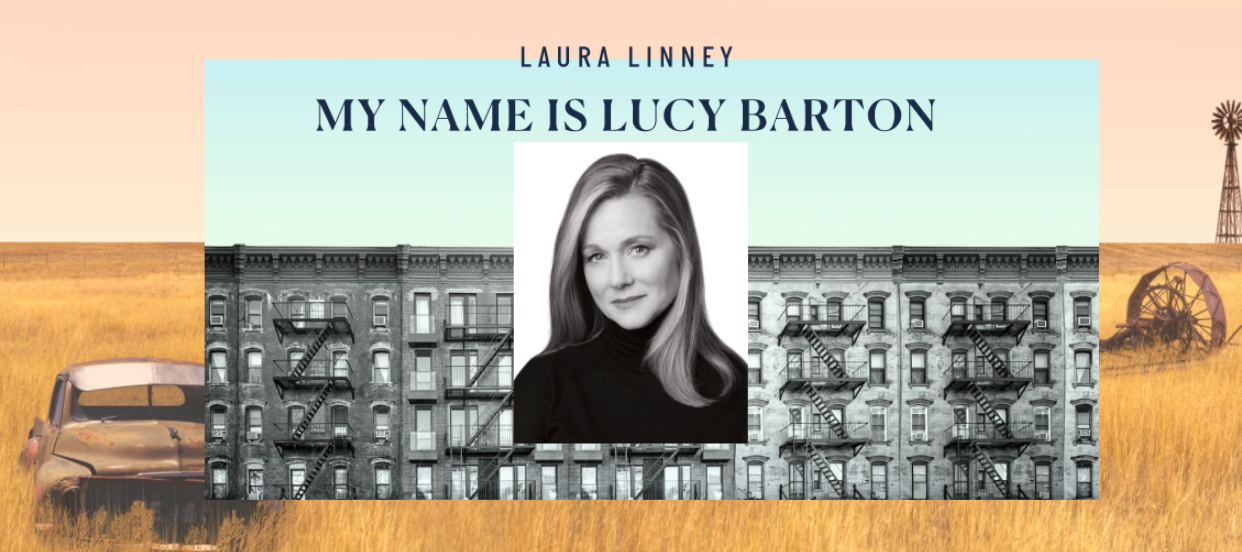
'My Name is Lucy Barton' at The Bridge Theatre

I've never read the book or even heard of it but this play is a one-woman play and starred Laura Linney in her London debut so it was well worth the trip over to Tower Bridge and the theatre. It's a strange tale of memories and the tricks they can play, of families and relationships and, most of all, parents and children.

The play is mainly set in a hospital room with Lucy is confined in New York. Her husband won't visit her because he doesn't like hospitals (says a lot about him) so he gets her mother to visit from out in the mid-west. They never got on for some reason but a bond grows between them as they talk and reminisce and Laura plays both characters. Then we start to whiz forward in time - it's the '80s so there's the inevitable mention of AIDs and then in's the 00's so we get 9/11. Her mother dies, and so does her father, she leaves her husband and becomes a successful author but still the tangles of family life continue.

I liked it well enough but I far preferred Laura's performance than the play itself. It's about 90 minutes long with no interval  and I just kept wondering how on earth she could remember all those words! There are a lot of words. I liked the lighting and projections onto the screen at the back of the stage so illustrate changing scenes while leaving the stage intact. There are few one-woman shows so it was good to see this one and to see Laura Linney on stage.