
Last week I went to see the 'Out Of Chaos' exhibition at the Laing Art Gallery in Newcastle. The exhibition is in association with the Ben Uri Gallery and is made up mostly of works in the Ben Uri collection. It's about migration and the impacts of migration but, since I visited the day before Holocaust Memorial Day and coming during a more current refugee crisis, and with Brexit and Trump all over the news, nationalism and exclusion of the other, it took on a slightly different meaning. There is forced migration and running for your life to remember, and, sometimes, it's the little stories around some of these paintings that make them come alive. There is also the sorrow of not being able to run for your life or being turned away, lives cut short and potential never realised, and that's partly what I took away from the exhibition.
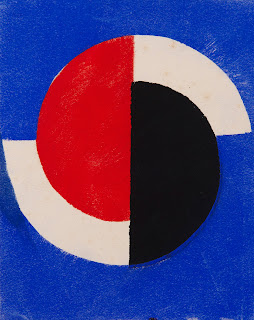
It's not all tears and there is joy in this exhibition, the joy of finding two Sonia Delaunay paintings I didn't expect to see. Walking into the room, glancing round and seeing these on the wall were a magnet for me. They were only small but small can be joyful - 'Design for a Poster' and 'Greeting Card' for Gallerie Bing, both simple little works but so very much by Sonia. Simple colours and shapes making the paint sing and say come, jump in and enjoy. Both works are from 1964 when Sonia had been settled for many years but she had spent her youth as a migrant, living in different countries and escaping wars but always working, always moving forward. Seeing any work by Sonia reminds me of the great exhibition of her works at Tate Modern a couple of years ago, everything from her early Fauvist-inspired works through her own art theory developments with her husband, Robert, to her final works.

Another quiet joy was seeing 'Svendborg Harbour, Denmark' by Martin Bloch from 1934. I've not come across Bloch before but the colours and shapes in this painting drew my eye across the room. Bloch was German who left his country when the nazis classified his work as 'degenerate' and moved to Denmark and then to Britain. Svendborg was obviously a busy harbour with boats and warehouses aplenty, jostling together with crates of fish and other goods bobbing on the tides, with a cloudy sky ready to drop rain at the first opportunity. Merchants and workers are behind those green walls keeping dry and warm - I can't see them but I know they're there while Bloch sits and sketches on the quayside.
A charming naive painting is 'Shtetl' by Chana Kowalska, in lovely bright colours showing a village scene. Bright houses with a water pump in the middle of the road for the people to share, tree-lined streets and a telegraph pole linking the village to the wider world and to the city (see the little dome of a church in the distance). The detail of the cobble stone street is lovely. This is the old world on the cusp of change, a nostalgic look back to a more idealised - and safer - past.

Chana Kowalska was a migrant. She moved from Poland to Berlin to Paris, the daughter of a rabbi, a teacher and journalist as well as a painter. By the time she painted this work in 1934 she was already looking back to a time that had almost vanished. When the Second World War reached Paris Kowalska joined the French Resistance to fight the nazis and, in 1941, she was captured, deported and killed. Her life was cut short at the age of 37 but she fought for what she believed in and against the enemy, like many others. Who knows what she might have gone on to create if she had lived?

On the wall beside 'Shtetl' is the larger 'Crucifixion' by Emmanuel Levy. Levy was the son of Jewish migrants to Britain and he grew up in Manchester so his experience is very different to many of the other artists in the exhibition. He painted this in 1942 as a protest about the news coming from Europe during the war about what was happening to Jews being rounded up from cities and towns and vanishing into camps. I'm not sure whether it is showing Christ as a modern day Jew or is meant to show the mockery of Jews by imitating Christ. The sign above his head, 'Jude' places the painting clearly in the era and the persecution of the Jews by the nazis with the figure looking up to God while his prayer shawl flaps in the breeze. By extension, the smaller crosses littering the field and going back in the distance represent other Jews, now dead and buried. It's a powerful image.

Further along the same wall is 'Interrogation' by George Grosz from 1938, a terrible, painful work in rough ink and colour. A half-naked man, beaten and bloody, with a nazi officer looking on smoking and not reacting to the horror in front of him. Grosz lived in America when he made this and it's a powerful and terrible work. The casual brutality is awful and thats why this painting needs to be shown and seen, especially with the current rise of nationalism and bigotry. We need to see where extreme nationalism can lead.
A final painting to mention is 'Refugees' by Josef Herman from 1941. He painted this in Glasgow after he had fled from Warsaw following persecution of the Jews and escaped from Brussels in 1940 when Germany invaded. It has a strange nightmare quality, thickly painted, showing a family fleeing for their lives under the moon with a suggestion that the hunt has begun. Carrying a few meagre possessions to start a new life somewhere else - if they make it.
There are other works by a wide range of other artists (including Marc Chagall and Frank Auerbach) but these are the ones that stick with me. It's not a pleasant exhibition but it's needed and now is the right time to be reminded about the lowest points of the 20th Century. I'd suggest that some of our current world leaders should see this exhibition but that would sadly be a waste of breath.
The exhibition is on until 26 February 2017 so if you're in Newcastle I'd urge you to see it.
 I first saw 'Laus Veneris' in 1976 at the Laing Gallery in Newcastle. I last saw it in 2018 at the exhibition of Burne-Jones' works at Tate Britain. It was the painting featured on the posters and on the cover of the catalogue. It's based on a poem by Swinburne in which Venus looses her love and here she sits, all languid and love-lorn, being entertained by her maids while knights ride past outside and are seen through the window. It's incredibly decorative and full of details, just look at that tapestry in the background.


