Friday, 19 August 2016

The Bolshoi Ballet at the Royal Opera House

The Bolshoi Ballet has enjoyed a summer season at the Royal Opera House while the Royal Ballet has been having a holiday. It's the 60th anniversary of the Bolshoi's first shows there and, since I've never seen them before, I had to get tickets to see these famous exponents of ballet.

I got tickets to see 'Don Quixote', 'Swan Lake', 'The Flames of Paris' and 'Le Corsaire' (hey, pirates, obv I got tickets!). The tickets were more expensive than normal but that's only to be expected for a special attraction and all shows sold out. The thing that I was quite surprised about when I attended 'Don Quixote' was that there was merch! I don't know why I was so surprised - if I was touring the Bolshoi I'd have merch (and a lot more than they had) but it did have surprise element to it. Tee shirts, tote bags, teddy bears in lunch baskets, and, of course, a special (and specially expensive) tour brochure. I bought the brochure but avoided the other stuff.

My first Bolshoi show was the quixotic 'Don Quixote', the tale of the good Don's misadventures along with his side-kick, Sancho Panza, but it's not really about them. They're a means for other things to happen in true picaresque style rather than them being the things happening. We have a short introductory scene that shows us the ancient knight deciding to head out into the world and then we're off. We did see windmills in one scene but no knightly charging and vanquishing.

On the other hand, the production was a riot of colour and movement and an incredibly full stage. One of the many things the Bolshoi does really well is crowd scenes, people everywhere but not impeding the principals as they show off. And that's what I learned from 'Don Quixote' was the main difference between Russian and British ballet - the Russians do endless showing off of their technical excellence, including bows mid-scene, whereas those reserved British types don't! And it was wonderful! To see the principals doing their thing and then the whole audience exploding into applause was wonderful. I'll never forget Maria Alexandrova starting at the back of the stage and going up on tippies and going round and round and round and round gradually moving in a straight line to the front of the stage. Wow! That deserved applause and she certainly got it!

The second performance was 'Swan Lake' which I had been looking forward to for a while. I've seen (and love) Sir Matthew Bourne's version of the classic tale but never seen the traditional 'Swan lake' so I was very keen to see it danced by the Bolshoi. And I wasn't disappointed, it was really good with much showing off from the Swan as well as from the prince.

The Swan was beautifully and elegantly danced by Olga Smirnova and the prince was danced by Vladislav Lantratov who also danced our hero, Basil, in 'Don Quixote'. Both of them - and the whole corps - deserved every bow they got, they were splendid! Olga's party piece is obviously dancing round and round and round on hippies but diagonally down the stage and Vladislav's in making impossible leaps across the stage. Such athleticism from them both, captured together and creating beauty. I loved it.

The third production was 'The Flames of Paris' about the French Revolution and this was the only ballet from the 20th Century and the least enjoyable. It seemed to not really know what it wanted to be or what it wanted to say (other than down with the aristocracy). The first act was full of exposition as to why the current regime needs to go and then virtually the whole of the second act is taken up with a court entertainment with no story telling at all until we hear the shouts of the crowd off-stage as the revolution begins. Having said that, I loved the court entertainment and all the fancy footwork and showing off it contained!

This again starred Maria Alexandrova and Vladislav Lantratov as the main characters, along with Denis Savin, and, although they struck some really good revolutionary poses, it was more hit and miss than previous productions. Not through any fault of their or of the corps, but because it was an odd production that kept seeming to stall after running forward with the story. That made it quite confusing to watch - what are we looking at now? I'm pleased I saw it if only to show that the Bolshoi is subjected to the material it's given but what a joy their crowd scenes are, very spectacular!

The final production was 'Le Corsaire', a ballet I'd seen danced by the English National ballet last year and which I've wanted to see again. The Bolshoi gave me the perfect opportunity.  It has scenes of men in turbans and colourful robes, of pirates vigorously fighting and swashbuckling, and of beautiful courtesans winning custom by their exceptional dancing. It's an exotic tale of love and mutiny and the power of wealth and weapons - well, it's based on a poem by Byron. It was also, ultimately, rather disappointing in its delivery.

The principals of Anna Nikulina, Mikhail Lobukhin and Nina Kaptsova were excellent but the corps were less so. The dancing wasn't terribly synchronised and the lines weren't always straight - hardly a big thing but we expect perfection every time from the Bolshoi and that's not what we got except for the glorious floral dance scene which was a spectacle to behold. It didn't really help the plot move forward at all but it was gorgeous.

The Bolshoi Ballet was excellent and I'm so pleased that I've seen them so early in my 'ballet appreciation career'. I have seen some tremendous dancing and technical achievements, spectacular  sets and costumes and great music (the ballet brings it's own orchestra with it, of course). I did find stopping the ballet for the principals to take a bow after every grand piece rather frustrating - at the same time as wanting to clapclapclap - since it interrupted the narrative but it's nice for them to get their own applause. Ultimately it was technical brilliance over story-telling and romance and that's what I'm used to from the Royal Ballet. I love a bit of showing off but I also want to fall into a story and be swept along by it.

The next time the Bolshoi comes back to the Royal Opera House I'll be there in the audience ready to be amazed but I'll have a better idea of what to expect - and I'll bring my special pair of clapping hands! Thank you Bolshoi!

Wednesday, 17 August 2016

Bhupen Khakhar at Tate Modern

There's a small exhibition of paintings by Bhupen Khakhar at Tate Modern at the moment called 'You Can't Please All'. I'd not heard of Mr Khakhar before and didn't know what to expect and I'm still not really sure what I've seen at this exhibition.

It's the first international retrospective of his work since he died from cancer in 2003 (and his paintings trying to depict his experiences during cancer are painful to see). I've been to this exhibition twice because I couldn't decide whether I liked the paintings - or whether they were good - on the first visit. And I still can't.

They're narrative paintings and tell a story, whether a re-telling of an old Indian yarn, tales of village life or being gay in India today. There are also hints at public and private life such as in the painting above of the man on the balcony - to the world on the other side of the balcony he's bare-chested and probably wearing a dhoti but we can see that he's actually naked. Just why he's naked I have no idea.

There are quite a few naked men in his paintings, often aroused and inter-generational like in this painting. The large couple are clearly the most important in this painting, but are we seeing the result of the story? do all the smaller images lead up to this larger image? Or are they all disconnected and random? Are they lovers or is this a business transaction with the younger man being a masseur? Who knows.

Most of the paintings use very vivid colours (that don't really come across in the images for this blog) and the figures are quite stylised and often quite awkwardly posed. I can't quite work out why this should be other than the artist was trying to create a style or an image for his work. I'm not sure it works.

A painting I did like was one he did based on a short stay in Britain in the late 70s, called, I think, 'Man in a Pub'. There is the man sitting in his coat, drink in hand, with other images of random men to his left. And sitting right between his legs is his hand holding his limp driving gloves, an image of impotence compared to the other phalluses in some of his other paintings if ever there was.  Maybe there's a not so subtle message here for the former rulers of empire?


As I said, I can't decide if I like these works - go along to Tate Modern and decide for yourself.

Monday, 15 August 2016

'Into The Woods' at the Menier Chocolate Factory

Last week we went to see the new production of 'Into The Woods' at the Choccy Factory, possibly my most favouritist Sondheim show. I saw it at the Regents Park Open Air Theatre in the woods (an ideal location) a few years ago with Jenna Russell and Michael Xavier so any production has a lot to live up to. This version is imported from America with the Fiasco Theater's production and it is well worth seeing.

'Into The Woods' is the story of all those old tales bunched together so we have Red Riding Hood, Cinderella, Jack and the Beanstalk and more all wrapped up together and interacting. Prince Charming marries Cinderella and his brother marries Rapunzel. And, of course, there's a witch, because there's always a witch and she lives next door. The first half of the play tells us the stories we all know (well, mainly, although there are some twists) and the second half tells of the potential consequences. Is Cinderella happy after marrying her Prince Charming? What happens to Red Riding Hood after her ordeal in the forest? And how does Jack turn out in the end? Do they all live happily ever after? You'll have to get a ticket to find out for yourself.

I liked the staging, with its backdrop of ropes strung floor to ceiling to give an impression of being in a wood and there's wood everywhere (and a smell of wood in the air). The piano is the main prop on the stage, wheeled around while being played and various chairs and tables brought on every now and then, including a set of step ladders to be Rapunzel's tower. It all worked very well. I liked the stripped back keyboards hung around the stage to decorate it and the small chandeliers hanging on stage and out into the audience.

The cast is a mix of Americans from the Fiasco Theater and British home grown actors and they gel really well together giving us a very organic production, growing and weaving stories together. I particularly liked Harry Hepple as the Baker (and who I've seen in a few things over the last few years, including 'Pippin' at the Choccy Factory), Laura Tebbutt as the Baker's Wife who has a lovely voice as does Claire Karpen as Cinderella (who turns out to be a hero, obvs) and Emily Young as Red Riding Hood and Rapunzel. Most of the actors played a couple of parts. I also liked Vanessa Reseland who brought a curious intensity to the role of the Witch who is so central to much of the action and leaves so heroically through the audience.

I enjoyed this production very much and so will you as soon as you buy tickets. And don't forget your magic beans.

'Sunken Cities' at the British Museum

The latest big exhibition at the British Museum is all about two cities that sunk into the Mediterranean and vanished until they were re-discovered by accident in the last century, the cities of Thanis-Heracleion and Canopus. The underwater excavations began in 1996 and they've found some fascinating stuff so far.

A lot of the exhibits aren't necessarily Egyptian but are Greco-Egyptian from the period of the Ptolemies, the dynasty appointed by Alexander to rule that part of his empire.The Ptolemies adopted many Egyptian customs to bolster their right to rule - using the title pharaoh rather than anything else, marrying within the family, becoming objects of godhood, building temples to Egyptian gods and associating themselves with the local deities - but their Greek heritage also came with them.

One of the more obvious examples of this mixing of the cultures is this lovely life-sized statue of Queen Arsinoe II with its typical Egyptian striding forward movement of royal statuary but the delicacy of the drapery around her is typically Greek, making the cloth almost invisible. You can walk round this statue and it's just as good from behind with the delicacy and movement of the buttocks and thighs.

A big 'wow' moment was the first glimpse of a giant bull, Apis in all his glory. So solid, so there and the detail of his face is wonderful. He is a startling and imposing sight and gathered many visitors to examine him in detail, just like I had to. He wears a solar disc crown (which you can't really see in this photo) to signal his divinity. Bulls were worshipped in many parts of Mediterranean cultures over the eons and it's easy to see why in this marvellous sculpture.

Some of the exhibits have video screens beside them so you can see clips of the archeologists in their diving suits finding the exhibit and excavating it. That's quite a novel approach and works really well when you can see the artefact all cleaned up and there in front of you. Some of the colossal statues were in several pieces when they lay in the sea but have been put back together again such as this statue. It's all terribly impressive.

There was a pair of matching statues of Isis and Osiris at the start of the part of the exhibition that focused on the Osiris mysteries and ceremonies. They are gorgeous and in seemingly perfect condition. Those ancient Egyptian sculptors knew how to work their stones to perfection and there are some tremendous examples of the wonderfully smooth textures in the lovely museum at Luxor which I visited years ago. This pair of statues are really marvellous in their detail and craftsmanship, stylised of course, but that's part of their joy. I went back several times to take another look.

I think this is the British Museum's best exhibition for a while and well worth visiting. There's so much more to the exhibition than I mention and some wonderful - and very informative - artefacts. I loved the statue of Horus protecting Nectanebo II, the last truly Egyptian pharaoh, and the statue of Taweret near the exit - now she's a goddess worth worshipping! My advice? Go and see this exhibition if you can, it's definitely worth a wander round and something to marvel at. Well done British Museum!

Sunday, 14 August 2016

'Dutch Flowers' at the National Gallery

There's a lovely little exhibition of floral paintings on at the National Gallery at the moment called, simply, 'Dutch Flowers'. It's in Room 1 beside the front entrance to the Gallery and is made up of a couple of dozen paintings of flowers by Dutch artists over the 1600s - 1700s at the peak of the Dutch fascination with flowers.

As well as the riot of colour in the paintings, it's worth looking at the fine detail, the insects seeking nectar, the fruit tucked in beside the flowers and, occasionally, the dead fowl. I wasn't keen on those. Given the incredible detail it's quite surprising how small these paintings are, none more that about 2'6" high so how these artists managed to fit so much detail in is quite astonishing.

As the signs for the paintings made clear, none of them are particularly 'real' portrayals of flower arrangements since they include flowers that aren't in season with one another. I get that, but it sort of makes them even more impressive that they were painted over at least a year as different flowers came into bloom, and keeping the composition a unified whole. That might help explain the inclusion of so much fruit and some fowl to keep the paintings 'alive' while waiting for the next flower to bloom.

They are quite astonishingly detailed paintings and you do need to look at them carefully. I've been to the exhibition three times now and appreciate it more with each visit. It's open for another few weeks so take a look if you can - it's quite small and in one room so it won't take a lot of time but it's nice to have the paintings grouped together as they are.

Saturday, 13 August 2016

#1MillionSteps for Diabetes UK

I haven't done much blogging over the past month or so and that is, in part, due to committing to take the 1 Million Steps Challenge to raise money for Diabetes UK. That means walking at least 10,000 steps every day between 1 July and 30 September. I haven't managed that every day but on other days I've massively exceeded it and got some spare steps in my steps bank. I'm a diabeatnik myself and have Type 2 diabetes so I have a vested interest in raising money for research and support for diabeatniks and also into the end result of being more active, that is, a healthier me! In the last week I've exceeded 500,000 steps so I'm on track to complete the 1 million a week or two early.

It would be quite difficult to achieve 10K steps by pottering about at home (well, unless you live in a mansion, I suppose) so that in itself has encouraged me to get out and about more and to walk more. So, instead of getting the bus to the tube or railway station, I now walk. The walk to the station takes me past streets I've never walked down and parts of Tooting Common I've never explored, so I take diversions and see what's at the other end of the street. That increases my steps and it helps me better understand my area of London and what great stuff I live beside.

Instead of getting the tube to the nearest station to wherever I'm going, I get off at the station before that and walk. That helps me see things I wouldn't normally see. I was recently on a one week course at the National Gallery so I got off at Embankment rather than Charing Cross - not a huge difference really, but it gave me another 1000 steps each morning when I arrived and each afternoon going home.

Being at the National Gallery gave me Trafalgar Square to step round at lunchtime and the Gallery itself to explore, as well as Covent Garden down the road and a host of other things. I'd never had lunch in Trafalgar Square before so I made a point of getting some sandwiches and water one day and sitting int he Square to watch the tourists and other lunchers. That's a very small thing but, if I wasn't counting my steps, I would probably have just gone to the Gallery cafe for lunch rather than going outside or parading up and down the galleries exploring the art. It's often the little things like that that add the extra steps I need for the bank.

The challenge has also encouraged me to walk to events rather than get the bus - it means leaving earlier than I normally would but that's no great hardship. I set an early personal achievement of 28K steps in one day by walking to the Lambeth Country Show in Brockwell Park, wander the show for a couple of hours and then walk home a few weeks ago. I last went to the show 20-odd years ago but it was great fun and I loved the beer glasses (so nice I had to have two pints to get two glasses).  That's helped me to re-discover Brockwell Park, it's pond and lovely walled garden, rolling grasslands and picnic areas as well as all the fun of the show itself. The summer sunshine helps, of course.

I've also discovered things a lot closer to home on the two commons I live between - Tooting Common and Streatham Common. Tooting Common is a huge area of parkland bordering Tooting, Balham and Streatham. As well as its famous open-air swimming pool at the Lido it includes acres of grassland, some areas mown short for sports and some left to grow wild, areas of woodland, some recreational facilities for children and tennis courts and, of course, the lake. I wasn't sure if it was a big pond or a small lake but, after many visits, I've decided it's a lake since it's big enough and has a large island in the middle. It's great for wildlife and I like to see the swans, the occasional heron, geese and the shy turtles that appear on a sunken log at one side of the lake. It's very popular with mums and kids who feed the birds despite the signs asking them not to.

The secret joy of Streatham Common is the Rookery, the old gardens of a mansion house that used to stand at the top of the Common but was pulled down a century ago and the gardens were bought by public subscription to remain open to the public. I've known about the Rookery for years but never actually been, so the steps challenge gave me the incentive to visit and I'm jolly pleased I did (and I go back regularly to see them change as plants bloom and wither and others take their place). It really is an astonishing garden up there on the hill and, if you walk further along to Norwood Grove house you get great views across south west London and out over Surrey. You'd hardly believe you were in London sometimes.

Visiting Commons and gardens means I've seen more flowers this summer than in many a year. London is such a green city but it's sometimes difficult to believe that from what we see on the television news and films. Streets and bricks, traffic and concrete, but my London is full of green and growing things, lots of trees and flowers, blackberry bushes and nettles. As well as Tooting Common and Streatham Common, I've visited Brockwell Park, Figge's Marsh (there's no marsh there, sadly), St Jame's Park, Embankment Gardens, walked past so many gardens both big and small and seen so many flowers. Endless flowers and bumble bees having their lunch of nectar. I keep my eyes on the olive tree in the Rookery in case it starts producing olives. Now that we're into August the blackberries are starting to appear and so are all the hips and hawes on the bushes - it's going to be a very fruitful autumn following all the sunshine and rain we've had.

The steps challenge has also made me take advantage of my surroundings and see things that I've known about but never actually bothered to see. Visiting the Rookery was a joy and, now that I've discovered it, it's somewhere I will keep returning to regularly as the seasons change, but today I visited Brixton Windmill for the first time. I've known about it for decades but never quite managed to get there. It's one of the last few windmills in London but it's definitely worth a visit - it's occasionally open and you can go inside. I was just pleased to see its dramatic exterior with it's white sails and black building. It's about half-way up Brixton Hill (or down, depending on your direction) and is definitely worth a visit.

I also visited the Black Cultural Archive while my steps took me to Brixton and the small but very informative exhibition about the history of Rastafarianism. The Archive only opened a couple of years ago on Windrush Square and I'd never been before so this was a perfect opportunity. I also took the opportunity to explore Brixton markets (I remember my first visit 30 years ago and buying a sweet potato, something I'd never tasted before) and visited the David Bowie mural opposite Brixton tube station to see that some new floral tributes had been left for the Starman. There was a huge mound of flowers back in January and every now and then since - they keep getting cleared away after a respectful time but they keep reappearing.

So, the 1 Million Steps Challenge is raising money for Diabetes UK which is a good thing in itself. But it's also good for me. I'm losing weight and becoming fitter, I'm discovering the joys of the area of London I've lived in for years but never had the time or the motivation to explore more fully, and I'm becoming more observant to compete in the Diabetes UK weekly Twitter challenges (I've won twice so far as well - firstly about wildlife I've come across and the second about actual steps). Little things count and can be important as can all the little decisions to walk rather than get the bus or a train to get in a few extra steps or to see a street I've never walked down. I hope I continue after the challenge!

Tuesday, 9 August 2016

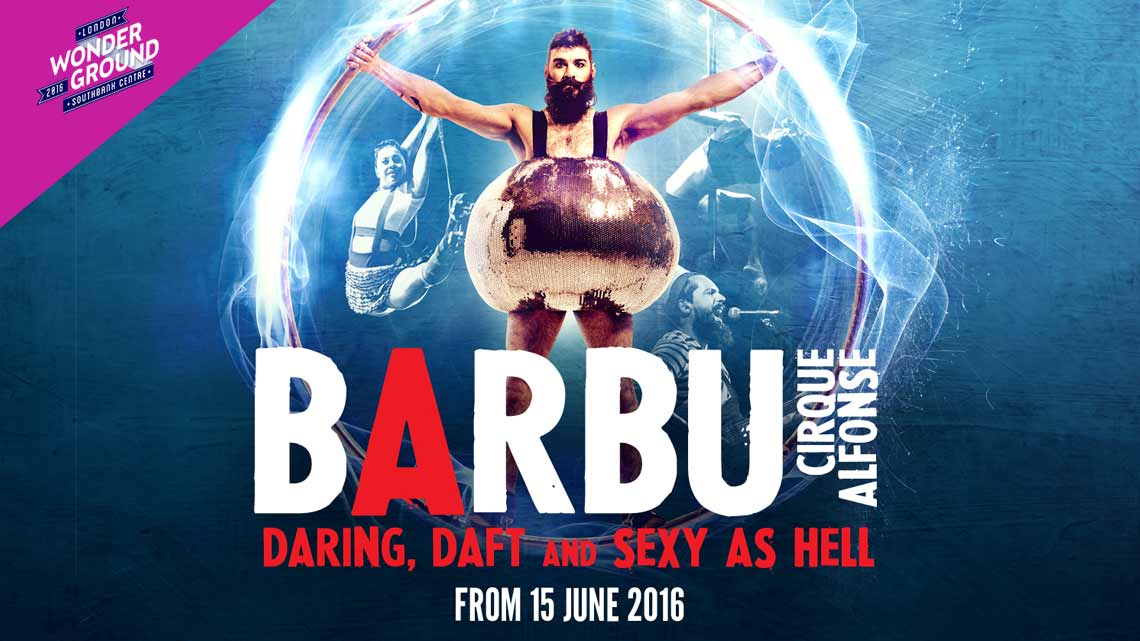
'Barbu' by Cirque Alfonse at Wonderground

A few weeks ago I went to the circus at Wonderground on the Southbank - Cirque Alfonse has returned with their new show, 'Barbu'. And it is amazing!

Yes, beardy bloke wears a glitter ball while playing inside a giant hula hoop and yes, they do come on in their black M&S pants (and bras for the women) towards the end of the show. They do actually wear clothes as well.

I was grinning from start to finish, two rows back from the stage and safe from any potential audience participation in the middle of the row. And on they came whizzing about on roller skates, moving on to strong-man scenes, twirling ribbons, strong man scenes (how on earth do they do that?), multiple juggling and so much more. It's a fast-paced show that quickly moves from one scene to the next all powered by the original music from the threesome band who join in some of the antics.

I can't start to wonder how many bruises they all got - and probably still get - as they created ad practiced these scenes. Careering round the small stage on skates and throwing things - and each other - around must be a nightmare to get right but, on the night, it is great entertainment and quite thrilling to watch.  It's also tiring to watch - non-stop movement  including throwing a full keg of beer around before breaching it to see it spurt into the air! I admit to wondering whether he ever lost his hold on it and it shot into the audience to flatten someone...

And beardy bloke in his giant hoop - what's that about? How on earth can he keep upright, especially wearing a glitter ball? But he does. Round and round that small stage, using the hoop in different ways and being thoroughly entertaining! I loved the show and would recommend you see it if you can - you won't see anything else like it.

Well done lads and lasses, you were marvellous and I look forward to your next show. Keep the beards, they suit you!

Monday, 8 August 2016

'Painters' Paintings' at the National Gallery

The current big exhibition at the National Gallery is 'Painters' Paintings' and that describes it perfectly, showing paintings owned by painters. So we see which paintings by famous artists Freud owned, Matisse owned, Degas owned (he had so many he gets two rooms), Reynolds owned and so on. Each famous painter has a room of his own to show some of the paintings he owned and, presumably, was influenced by.

There are some marvellous paintings in this exhibition - some, I'm sure, most people will have seen since they've been shown in recent exhibitions or are in the national collection but some were new to me and I'm pleased I've had the chance to find some new favourites. I'm very lucky because I could look at these paintings with fresh eyes after my recent course in the history of art at the National Gallery.

One of the paintings in Matisse's collection was 'Combing the Hair' by Degas. It's based on a black and white Japanese print but look at all that red and shades of orange and red. Degas never sold it and Matisse bought after his death, ownership followed by the National gallery. It's an oddly affecting painting with the woman holding onto her hair as a maid brushes it, red hair to match her boudoir.


Another painting that caught my eye was owned by Degas and painted by Georges Jeanniot, a painter I haven't come across before, called 'Conscripts'. It's hung next to Degas's own 'Young Spartans' and you can see the influence. The thing I like about this painting is the clear embarrassment and shame of the young men, stripping together and in front of a much older man as an officer. Heads bowed, hands covering themselves, you can almost feel the embarrassment. It's a very powerful painting.

One of my favourites was a surprisingly small painting by Raphael called 'An Allegory (Vision of a Knight)'. It was owned by Sir Thomas Lawrence (and his room is introduced by a self-portrait of him with baldy head) and I'd happily take it off his hands. It's really small which makes the detail even more marvellous.  Just look at that landscape, suggested by few brush strokes, setting the angels in place as the knight sleeps and dreams of virtues. It can't be a very peaceful slumber in that position but it seems to work for him. I'm not sure why the tree is positioned in the centre of the painting - it probably represents something but I don't know.

Another painting in the Degas rooms (his were separated into the moderns and the old masters) was this portrait of 'Monsieur de Norvins' by Ingres. He was the chief of police in Rome under Napoleon Bonaparte and. from the look of him, you wouldn't want to meet him in a dark alley. It's an astonishingly realistic portrait and, in the real thing, you can see the layers of black cloth on his coat and the odd red curtain framing the portrait. He's obviously full of himself and that comes across so well in this portrait. It's life sized and highly finished, an expert portrait from an accomplished portraitist.

The final painting I've chosen in a huge Titian in the final room of the exhibition, 'The Vendramin Family, venerating a Relic of the True Cross'. This was in the Van Dyck collection and takes up a lot of wall space. The first time I saw it I was all ho hum, and then I saw it again and caught the old man's gaze... and he captured me, telling me to remember him and his family. It is an astonishingly powerful painting with three generations of the males in the family but it's the old man that looks straight out of the family portrait right at you, the observer. I will remember.

It's a lovely exhibition and doesn't get too crowded so I'd encourage you to go and see it if you're in London and have an hour or so to spare.

Saturday, 16 July 2016

Sigiriya and Acrophobia

Twenty-odd years ago I went to the glorious island of Sri Lanka to travel around and see what was to be seen. I took a train up from Colombo to Kandy in the hills to visit the Temple of the Tooth and take part in the evening puja and travelled all over the place. One of the places I went to was Sigiriya, a rock fortress that rises out of the central plains and is murder to get to. The ruins of a palace are all that is left of ancient Singhalese royalty, along with some lovely frescoes on the way up the stairs. Ah yes, the stairs.

From a distance, it looks like the stairs up to the summit are built into the rock face, but they're not. They're built out from the rock on little stilts so you're walking over nothing but free air. Of course, I was part-way up before I realised this and by that time it was impossible to turn round because one set of steps led upwards and another set downwards. So I had to keep climbing and reached the top with wobbly legs and all I could think of was how on earth would I get down? Do they have a helicopter on stand-by to rescue tourists (I remember thinking this)? Do many people fall off in the average year? All sorts of things raced through my mind. So, I waited for the crowds to thin a bit so I could take my time getting down and started downwards rather than enjoy the fortress ruins. Of course, there was soon a long queue of people behind me but I wasn't going to be rushed. No. You can wait.

That's what started my fear of heights, the sheer terror of Sigiriya. And it's gradually got worse over the past twenty-odd years. A year or so later I was staying in a skyscraper hotel in Singapore that only had scenic, external lifts above floor six. It was dark outside so I got into the lifts not seeing that they were scenic above the sixth floor and imagine my terror as we went whooshing up? I got off as quickly as I could and walked up the stairs to find my room. That made for an interesting return to the hotel every day.

It's been getting worse over the years and while I used to merrily run up and down escalators I no longer do. I stand stock still gripping the handle like grim death and still think I'm going to fall. If I'm going to fall then I might as well get it over with and just let go and fall. And walking over bridges is just as bad - I can no longer do the Millennium Bridge of Hungerford Bridge and can only do Waterloo Bridge if I walk by the side of the road, away from the edge. I can't even use the see-through stairs in the Apple Store.

This is all very foolish of course and I know it is. But I can't help it. The panic sets in whenever I approach an escalator and I'm fine when I get off at the other end, all is forgotten and everything's fine. Until the next Tube journey and the next escalator. I've started to challenge this irrational fear and won't let it hinder my travels around London - I walked up the escalator at Embankment the other day and felt fine so perhaps that's the answer? Don't stand still and be a passenger, walk and take control? We'll see...

Saturday, 2 July 2016

'The Flying Lovers of Vitebsk' at the Sam Wanamaker Playhouse

Last week we went to see 'The Flying Lovers of Vitebsk' at the Sam Wanamaker Playhouse at the Globe. I knew nothing about the play other than it was about the love of Marc and Bella Chagall so, naturally, I had to get tickets as soon as they went on sale. Bella was his muse for so many paintings - so many paintings of flying lovers, too - and I wanted to know more. The play is by Daniel Jamieson who wrote it 20 years ago but I've not heard of to before.

The play is essentially a double-header with just Marc and Bella for most of the time, joined occasionally by two musicians on stage. It opens with their first meeting before he vanished to Paris to learn his craft and to start becoming famous but not rich. He returns to Vitebsk in Belarus to marry Bella with the aim of returning to Paris but they get trapped there by the First World War and have to make the best of it. They survive through the Russian Revolution and eventually move on to France and then America where Bella dies during the Second World War. The play ends with Marc having lunch with the ghost of Bella - he's re-married by now but his new wife isn't his muse - and I loved the simple 'Sorry' to Bella for having re-married. She doesn't seem to mind.

This play is part of the 'Wonder' season, Emma Rice's first season as Artistic Director for the Globe, and is full of whimsy and simple magic. It fits right in with the 'wonder' theme - suspend your judgement and fall into the world this play creates, the magic and joy of love, and release your imagination. I loved it.

I wasn't desperately keen on the set with it's wooden poles sticking out all over the place but I loved the colour-washes that covered the stage with the newly installed lights.
  
Marc Antolin played Marc and Audrey Brisson played Bella and they had a lovely stage presence. I've seen Marc in plays before (including 'Into The Woods' and 'Taken at Midnight') and it was nice to see him in this dreamy production. Audrey is new to me and is definitely worth watching out for in future.

It's a gentle little play and I loved it. I'm very pleased that I've seen it. I even bought a programme.